
A complete list of industrial robot types
What exactly is the relationship between industrial robots, robotic arms, and manipulators? According to this siteStructural morphologyGive meFunctions and usesFrom two dimensions, the system organizes various types of robots and includes a classification index for over 1,300 models in our database, helping you quickly find the right one.
First, clarify three terms: industrial robot, robotic arm, and manipulator
Industrial robots ≠ robotic arms ≠ manipulators, but mixing them in daily life is understandable
Many people think that an "industrial robot" is just a moving "robotic arm" in the workshop, but this is actually oneStereotypes based on generalization。 To be precise, these three are the relationships of inclusion and inclusion, the whole and its components:
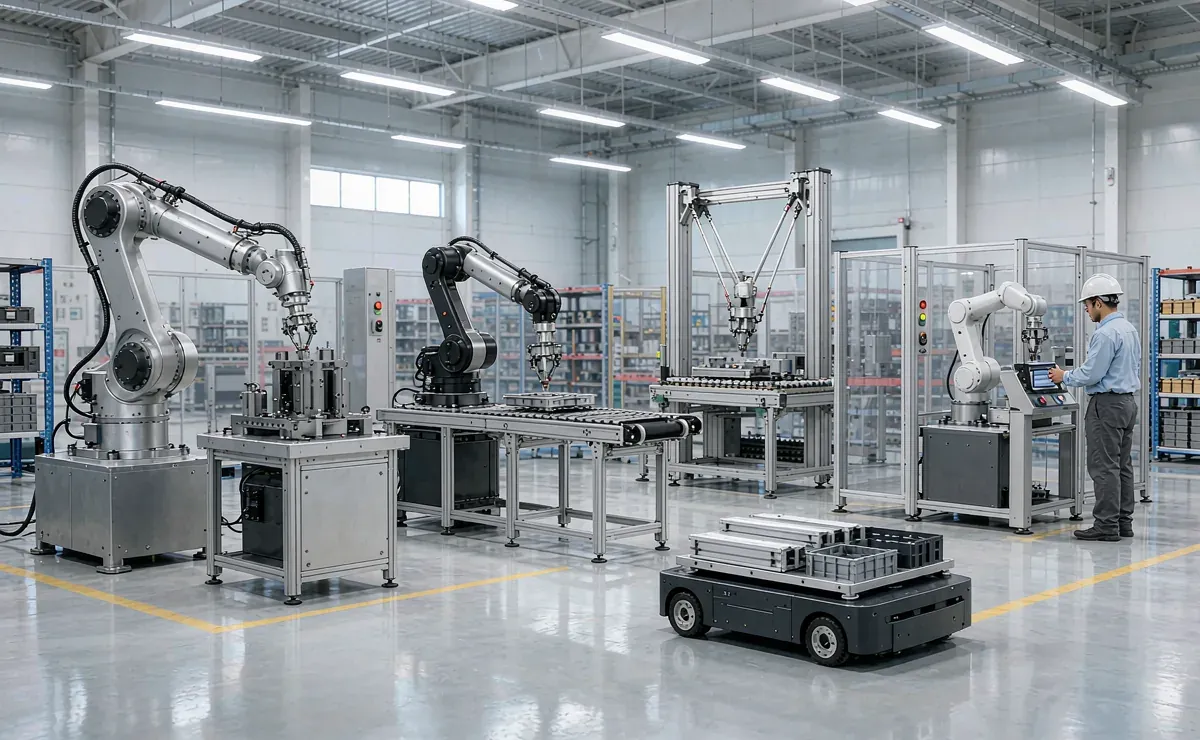
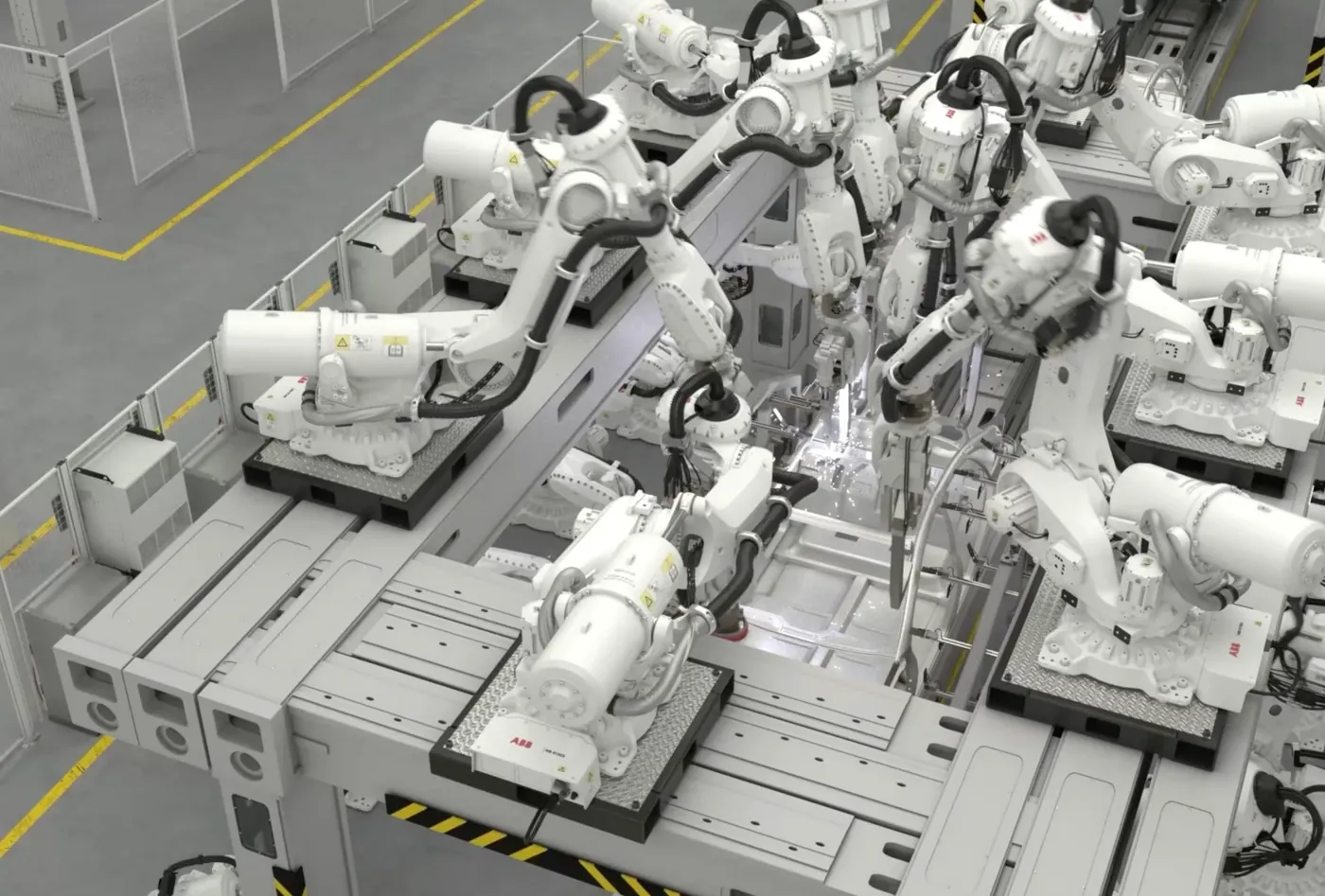
Industrial RobotIt is a complete automation system, defined according to the national standard GB/T 12643 (equivalent to ISO 8373), and consists of four main parts—The robotic arm itself(Mechanical structure executing motion),Controller(Brain, sending commands),End effector(Grippers/welding guns/suction cups, etc., the "hands" that directly touch the workpiece), as well asSensing and program systems(Vision, force, safety devices, and software). The moving "arm" we usually see is just the mechanical arm itself.
Robotic ArmSpecifically, it refers to the robot's main body motion structure—composed of several joints (shafts) and connecting rods connected in series, mimicking the movements of the human arm's shoulder, elbow, and wrist. It is the most prominent part of industrial robots, but not the whole picture. A six-axis robotic arm body must be paired with a controller to operate, and only with an end effector can it operate.
Robotic Hand / ManipulatorThe meaning is broader and more colloquial: in a narrow sense, it refers to the gripping device at the end (gripper), while in a broader factory context, it is often used to refer to the entire robot or robotic arm itself—the term 'manip' in 'injection molding manipulator' or 'loading/unloading manipulator' is this broad usage. SoWhen customers search for "manipulator" or "robotic arm," engineers often refer to the same thing as "industrial robot.", just different names.
| Terminology | Precise meaning | Put it simply | Usage scenarios |
|---|---|---|---|
| Industrial robots | A complete system of robotic arm body + controller + end effector + sensor program | A complete set of automated equipment | Academic, written, procurement contracts, national standards |
| Robotic arm / robotic arm | Robot body motion structure (joints + linkages) | That moving "arm" | Engineering and technical communication |
| Manipulator / Robotic arm | Narrow definition = end gripper; Broad definition = entire robot or main body | The "hand" that grips a workpiece, or generally refers to a robot | High-frequency terms in colloquial, workshop, and search engine terms |
| End effector (EOAT) | Tools mounted at the end of the robotic arm: grippers/welding guns/suction cups | The "tools" in the robot's hands | Fixture design and process plans |
Why does this site both use "industrial robot" and label "robotic arm (manipulator)"?
Considering customers' search habits—most people search on Baidu and Douyin for "robotic arm," "robotic arm," "welding robotic arm," or "palletizing robotic arm," rather than the academic "industrial robot"—our site uniformly labels products that are indeed robotic arm forms on the product and category page"Robotic Arm", accommodating search habits while maintaining professional accuracy.
Special notes needed:Not all industrial robots look like "arms"。 Delta parallel robots resemble spiders, AGV mobile robots are wheeled platforms, Cartesian coordinate manipulators resemble gantry cranes—all industrial robots, but not all "robotic arms." The following classification by structural form will explain each type one by one whether it resembles an "arm."
Six major structural forms: The robot's "appearance" is determined by its mechanical structure
Classification by mechanical structure is the most fundamental classification method
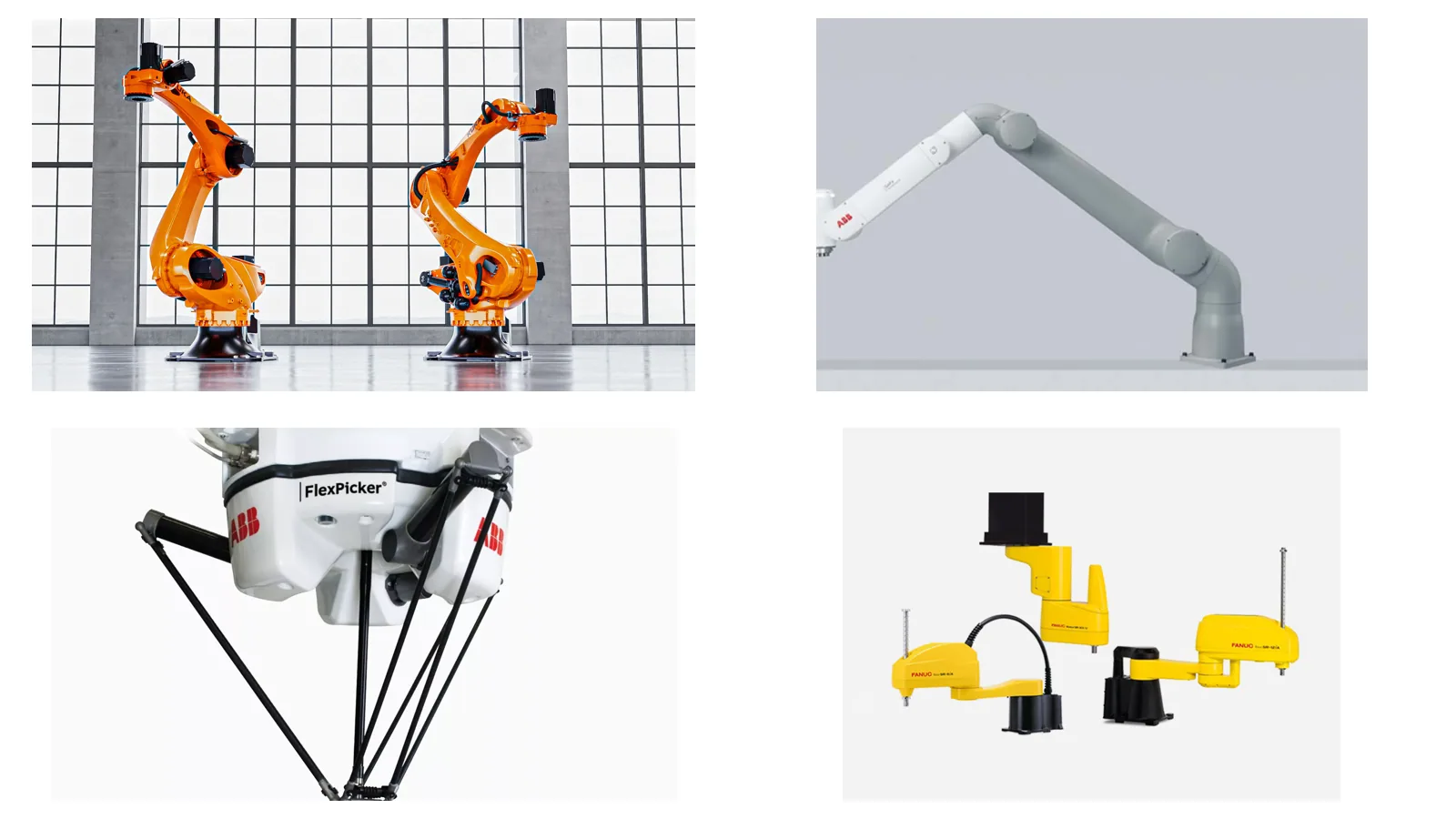
The structural form of an industrial robot determines its mode of movement, workspace shape, speed, and rigidity, thereby determining which process is suitable for it. The types of machines in the warehouse are divided into six main categories based on structure—the first five are broadly defined as "robotic arms/manipulators," while the sixth category (mobile robots) is not a robotic arm.
The most mainstream form of industrial robot, six rotating joints simulating human arms, allowing operation in any orientation within the space.
View category details → SCARA robotic armSCARA Manipulator / Horizontal Multi-Joint · There are 218 models in the libraryHorizontal multi-joint structure, high-speed, high-precision within a planar plane, excellent vertical rigidity, the main force for 3C electronic assembly and sorting.
View category details → Delta parallel robotic armDelta robotic arm / parallel robotic arm · There are 11 models in the collectionThree-arm parallel structure, extremely light at the end and extremely fast, capable of picking hundreds of times per minute, making it the preferred choice for sorting food and light small items.
View category details → Cartesian coordinate manipulatorTruss Manipulator / Gantry Manipulator · 0 models in the databaseIt moves along the X/Y/Z linear axis, has a simple structure, strong rigidity, and large stroke, commonly used for injection molding removal and truss loading and unloading.
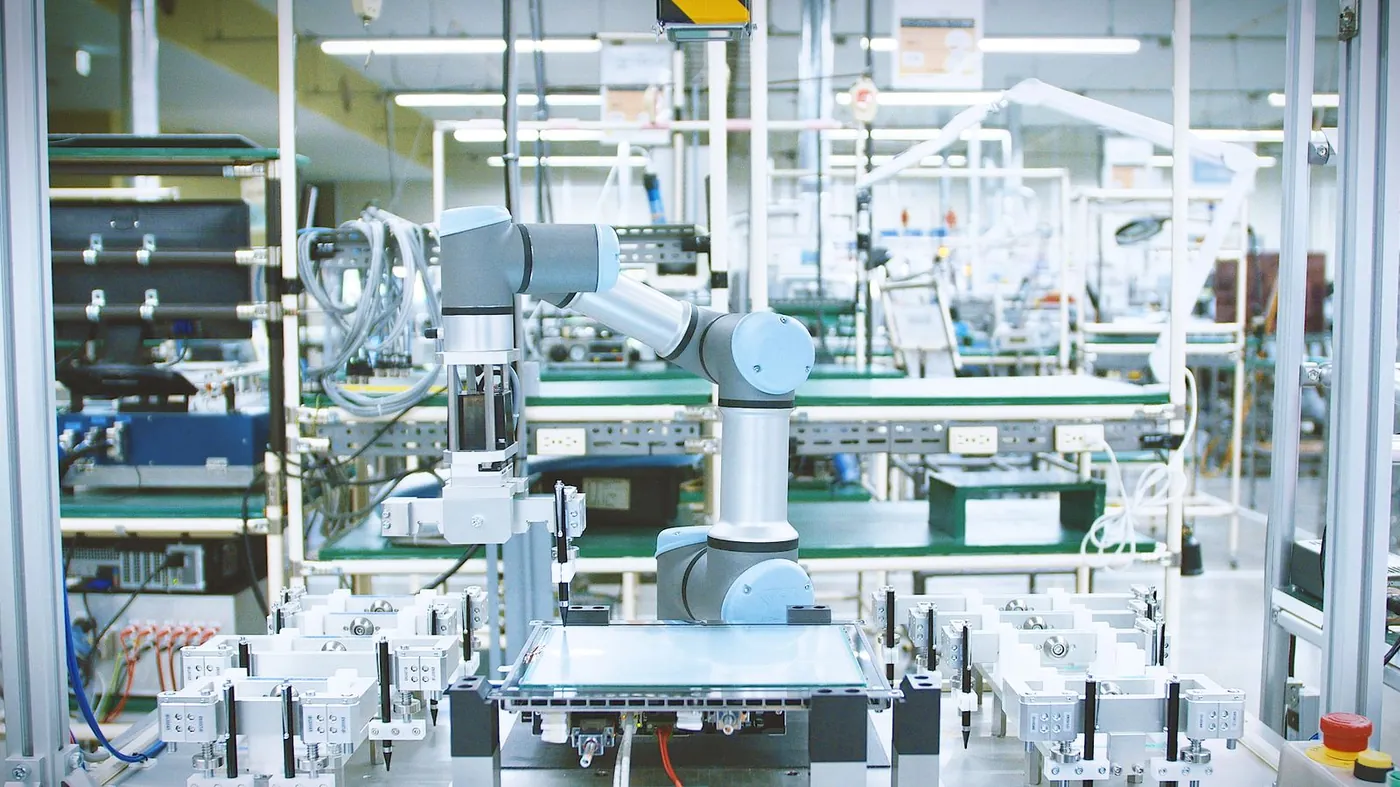
View category details → Collaborative robotic armCollaborative Robotic Arm / Human-Machine Collaboration · There are 123 models in the libraryEquipped with force sensing and collision detection, it can share workspaces with people, offers flexible deployment and easy programming, and is the fastest-growing small to medium-batch scenario.
View category details → Mobile robots AGV/AMRAGV / AMR Handling Robots · There are 21 models in the libraryThe wheeled mobile platform (not the robotic arm) is responsible for automatic material transport within the factory and is often combined with the robotic arm to form a mobile operation robot.
View category details →Five major functional categories: divided by "what work is done."
Functional classification is closer to the customer's purchasing language
When customers look for equipment, they often first think, "I want to weld" or "I want palletizing," rather than "I want a six-axis robotic arm." Functional classification is based on process use—the same functional category may require different robotic arms (for example, welding can use either six-axis or truss), with the key being the process package and configuration.
Arc welding, spot welding, laser welding—the main processes in automotive and metal processing.
View category details → Palletizing robotsPalletizing Robotic Arm/Manipulator · There are 61 models in the libraryStacking and unpacking of bags, barrels, and materials, high-frequency scenarios in food, beverage, and logistics.
View category details → Spraying robotsSpraying Robotic Arm / Painting Manipulator · There are 31 models in the libraryAutomatic spraying of paints, coatings, and adhesives is a must-have for the automotive and furniture industries.
View category details → Clean robotsClean Robotic Arm/Manipulator · There are 39 models in the collectionSpecially designed for semiconductor and pharmaceutical cleanrooms, low dust generation and resistant to disinfection.
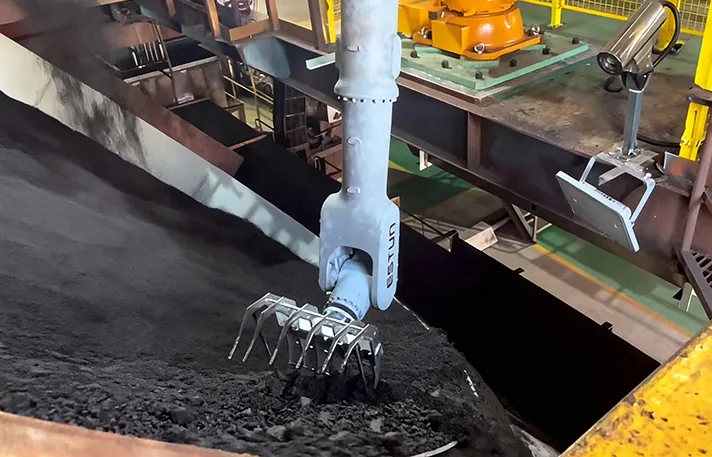
View category details → Special and specialized robotsSpecial Manipulators · There are 16 models in the librarySpecialized equipment for explosion-proof, vacuum, high-temperature, nuclear power, and other extreme environments.
View category details →Which robot should you choose? Four-step positioning method
| Step one: Check the craftsmanship | Step 2: Inspect the workpiece | Step 3: Check the beat | Step 4: Check the budget |
|---|---|---|---|
| Welding → six axes/trusses; Assembly → SCARA/collaboration; Sorting → Delta; Handling and palletizing → six-axis/palletizing special | Weight determines load, size determines arm reach, material determines end | High-speed sorting → Delta/SCARA; Heavy-duty handling → heavy-load six-axis | New lines → new machines; Mature craftsmanship → second-hand; Trial production → leasing |
Common Misconceptions Reminder
Misconception 1: The heavier the load, the better.Load must include the end fixture's self-weight and uneven load inertia. Blindly choosing a high-load model is not only expensive but also worse at high speeds. Enough + 20%–30% margin is enough.
Misconception 2: Six-axis universal.SCARA/Delta for high-speed flat sorting is faster and cheaper, while long-travel linear handling uses trusses for more economical operation—the flexibility of six axes is often "performance surplus" in many scenarios.
Misconception 3: Only looking at the price of the device.A fully usable automation unit usually only occupies 30% to 50% of the main unit; the end, peripheral, integration, and commissioning are equally important. Buying a "moving arm" doesn't mean buying a "system that can get things done."
What Henghuan can do for you
- Model selection consultation: Provides model and configuration recommendations based on process, workpiece, cycle time, and budget, enabling neutral cross-brand comparison
- Eight major business areas fully covered: application technology services, new machine sales, equipment R&D, algorithm R&D, leasing, upgrades, maintenance and repair, and second-hand sales and purchase
- Over 1,300 models in stock: 21 brands of robotic arms (manipulators) available in stock and second-hand, with inspection reports and warranty attached
- Local response: Local team in Nanchong, same-day delivery in Sichuan and Chongqing, 48 hours in Yunnan-Guizhou
Need robot selection, maintenance, or application solutions?
Tell us about workpieces, procedures, beats, and budgets. Local teams in Nanchong will connect with us, and on-site inspections are available in Sichuan, Chongqing, Yunnan, and Guizhou. Robotic arm (manipulator) selection, second-hand purchase and sale, maintenance and repair all in one place.
Contact usView all varieties