Sales of new industrial robots
We provide agency sales and selection services for brand-new industrial robots from mainstream brands, meeting first-hand equipment needs for enterprises to add new production lines and expand and upgrade production.
For customers with sufficient budgets who prioritize factory warranty and long-term stable operation, the brand-new robot is a more reliable choice. We act as agents for the sale of brand-new industrial robots from mainstream brands, and provide one-stop support from model selection and procurement to installation and commissioning.
Which brands and models do we represent?
We can connect with new models from mainstream brands such as FANUC, ABB, YASKAWA, Kawasaki, KUKA, INOVANCE, and ESTUN, covering small assembly machines in the 3-kilogram class to heavy-duty handlers in the hundreds of kilograms, as well as special structures like SCARA, Delta, and collaborative robots. The specific brands and model generations that can be matched are based on the manufacturer's current supply catalog. After receiving a request, we verify the model status and delivery time, rather than reporting a model that may have been discontinued. Note: As a third-party service provider, we do not act as the original manufacturer's agent, but instead complete your procurement through channels. Therefore, there will be differences in price, payment terms, and manufacturer policies compared to direct contact with the original manufacturer—we will clarify this when quoting so you can compare for yourself.
The complete process for purchasing new machines
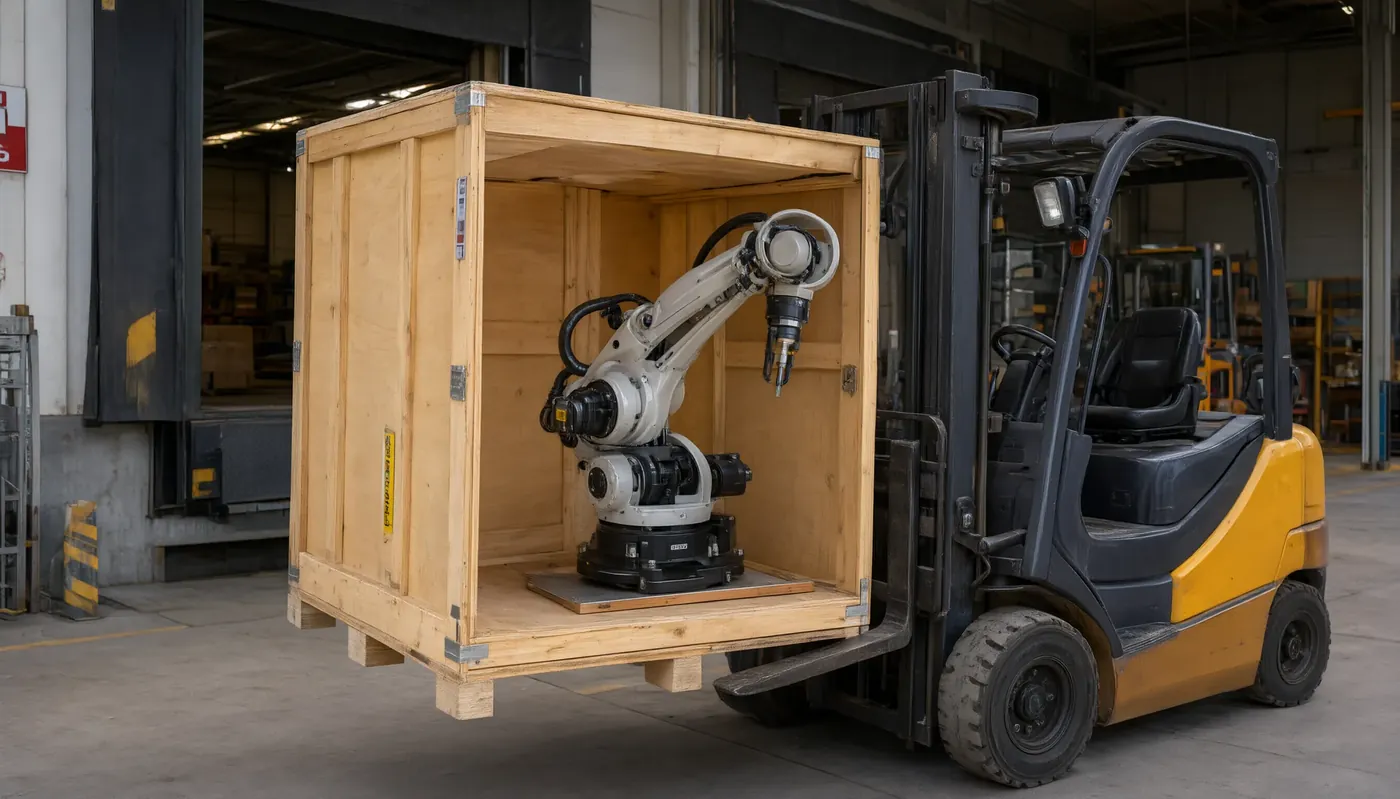
Purchasing new machines goes far beyond just paying for delivery. The complete process is: requirement confirmation and selection → Solution and quotation → Contract signing → Manufacturer placing orders and scheduling production → Arrival acceptance (unpacking and checking model, serial number, configuration list) → Transportation, hoisting and positioning → Installation, wiring, and powering → Zero calibration and accuracy retesting → Process teaching and joint commissioning → Trial production verification, beat rate and yield → Operation and maintenance training → Final acceptance signing → Entry into warranty period. There are two other easily bottlenecked steps in the middle: first, preparation of civil engineering and water, electricity, gas (foundation bearing capacity, reserved hole locations, power supply capacity, air source pressure, grounding resistance); second, interface protocols with peripheral equipment (PLC communication, safety signals, visual system integration). We clearly list the prerequisites and responsibility boundaries for these two stages in advance to avoid equipment being installed on site.
What's included at delivery
Standard delivery includes: robot body, controller, teach pendant, standard supporting cables, technical manual and certificate of conformity, and OEM warranty certificate. Optional value-added services include: on-site installation, positioning, wiring, and power-on, zero calibration and accuracy retesting, process teaching and program development based on your workpiece, signal coordination with upstream and downstream equipment, operator training (operation, teaching basics, daily maintenance), and trial production ramp-up support. We price these options separately and do not mix them into the equipment price. You can choose as needed, or complete some of them yourself to save costs—for example, companies with their own electricians and commissioners can do installation and wiring themselves, only entrusting us with process demonstration.
Comparison of decisions between new and used robots
This comparison is worth taking seriously, because the price difference is often several times higher. Strong certainty for new machines: OEM warranty on the entire machine, guaranteed parts and software upgrades, full invoice can be issued and counted as fixed assets, suitable for applying for technical upgrade subsidies and government project acceptance, and the latest controller platform and optional features can be specified. The shortcomings of new models are also real: high procurement costs, long lead times (popular models may be scheduled for several months), and the risk of production discontinuation is determined by manufacturer strategy. The advantages of used robots are low prices, fast availability, and the ability to purchase discontinued older models to supplement production lines; Weaknesses include short warranty periods, remaining lifespan dependent on cumulative working hours, dependence on the disassembled parts market, and inability to enjoy software upgrades and free training from manufacturers. There are three key variables in decision-making: budget constraints, time to go live, and the sensitivity of operating conditions to accuracy and stability. Choose new devices with a flexible budget and long-term stability; If your budget is tight, you need quick launch, or your working conditions aren't harsh, used robots are more suitable. The table below lists the differences in more detail.
What should be noted during acceptance?
There are several easily overlooked points during the new phone arrival inspection: First, verify that the nameplate model matches the contract, with special attention to suffix configuration (arm reach variants, protection level, special coatings); Second, unpacking and inspecting for transport damage; any dents, deformations, or damaged cables must be recorded and photographed on site; Third, after powering on, check the alarm history to confirm no abnormal records; Fourth, accuracy retesting is required, and repeated positioning accuracy must be confirmed to meet the sample nominal values; Fifth, verify that the included attachments and documents are complete (manual, certificate of conformity, warranty card, special tools); Sixth, confirm the start date and activation method of the original manufacturer's warranty; some brands require online registration. Final acceptance is only signed after trial production runs smoothly and the cycle and yield meet standards. When we are present, we assist with item-by-item verification and secure the acceptance results in writing.
Service process
From requirement integration to delivery and archiving, every step has clear outputs, without relying on verbal agreements.
-
01
Communication of requirements and model selection
We clarify application scenarios, workpiece parameters, cycle time requirements, budget range, and launch time, and based on this, we provide candidate models and parameter comparisons.
-
02
Plans and quotations
Provide equipment quotations and optional service quotes (installation, teaching, training) with specific quotes, specifying brand, model, configuration, delivery time, and warranty terms.
-
03
Contract signing
List equipment models and configuration lists, prices and payment methods, delivery time, transportation and insurance responsibilities, acceptance standards, warranty scope, and boundaries of liability between parties.
-
04
Manufacturers place orders and schedule production
Place orders with channels and track production scheduling and shipping progress, simultaneously providing you with technical documentation for pre-installation conditions such as foundation, power supply, and gas supply.
-
05
Arrival inspection and installation
Unpacking to verify model serial number and configuration, inspect transport damage; Positioning, wiring and power-on, zero point calibration, and accuracy re-measurement are completed.
-
06
Commissioning, training, and delivery
Process teaching and joint commissioning are performed according to the workpiece, trial production verifies cycle yield, operation and maintenance training are conducted, final acceptance is signed, and the warranty period is transferred.
This service covers brands and industries
Click to enter the brand page to view model specifications, or view application solutions by industry.
 FANUC
FANUC ABB
ABB YASKAWA
 KAWASAKI
 KUKA
KUKA INOVANCE
 ESTUN
ESTUN STÄUBLI
 Universal Robots
 Epson
Epson NACHI
NACHI COMAU
COMAU SIASUN
 EFORT
EFORT GSK
GSK JAKA
JAKA AUBO
AUBO TOPSTAR
 HSR ROBOT
 QJAR
QJAR Panasonic
Frequently Asked Questions
For the most frequently asked questions from customers, try to be realistic and avoid vague promises.
Are you an original manufacturer agent? Is there a price advantage?
We are not original manufacturer agents; we are third-party technical service providers who complete procurement for customers through channels. This means that in terms of pure equipment pricing, we may not be lower than direct sales from original manufacturers or major distributors. Our value lies in our neutral model selection (not limited to sales targets for a single brand) and the ability to handle subsequent installation, teaching, training, and long-term maintenance all at once. You can compare prices horizontally using our equipment quotes; we don't mind that. The real cost savings often come from subsequent commissioning and maintenance steps.
What is the typical delivery time for new machines?
Depending on the brand, model, and current production schedule, popular models may take weeks to months, while niche models may require special configurations for longer periods. When quoting, we verify the current delivery date with the channel and inform them truthfully, never setting an optimistic number and then postponing it. If your launch time is tight, we can simultaneously offer alternatives to used robots. Rent-to-buy is also a viable transitional path.
Does the equipment price include installation and commissioning?
The quotation is divided into two parts: equipment price and service price. Device price only includes the hardware itself; Installation and positioning, wiring and power-on, process instruction, joint commissioning, and training are considered technical services and are quoted separately by item. This disassembly is because different customers have different capabilities—companies with their own electricians and commissioning personnel can install it themselves, only buying teaching services, and there's no need to pay for services they don't need.
Can we just buy robots and write the programs ourselves?
Absolutely. We deliver hardware and basic commissioning (zero calibration, accuracy retesting, safety circuit verification), with process programs developed by your own team. If technical issues arise during later development, you can also purchase technical support services per transaction. Many companies with automation teams do this with more controllable costs.
How long is the warranty period? Who should you turn to when problems arise?
New machines come with the OEM full unit warranty, with the period determined by brand and model. We specify this when quoting. Issues within the warranty period generally go through the manufacturer's after-sales process, where we assist you in coordination and communication; If any issues arise during installation and commissioning, we will be responsible. For maintenance and fault repairs outside the warranty period, you can entrust us directly. Our response speed is usually faster than the manufacturer's after-sales process, and we are not limited by the original manufacturer's service area.
How to choose between domestic and imported brands?
Consider the sensitivity of the working conditions and your budget. Leading domestic brands (Inovance, Estun, etc.) can meet general conditions such as handling, palletizing, and loading and unloading in terms of load capacity, beat time, and stability, with clear price advantages, low parts costs, and fast local service response; Imported brands still have advantages in high cycle times, high precision, complex processes (such as arc welding, laser, precision assembly), and software ecosystems, and their long-term reputation is more stable. There's also a practical issue: if your customer or headquarters' equipment standards specify imported brands, then there's no choice. We will provide two comparisons in the plan, including initial investment and three-year maintenance cost estimates.
Can a special VAT invoice be issued?
New machine procurement can issue special VAT invoices, with invoice information and tax rates implemented according to actual transactions and tax regulations. Please specify your invoicing requirements and entity information before signing the contract. We will clarify this in the contract to avoid future disputes.
What if the equipment arrives and we don't know how to install it?
You can entrust us with installation, commissioning, and training, or purchase only part of the service. Preparations for the installation stage include: a foundation meeting load-bearing requirements, power supply capacity and grounding, air source pressure, hoisting equipment, and working space. We provide a technical documentation list in advance. You prepare according to the list first, and then we enter the site, achieving the highest efficiency and lowest cost.
Need business cooperation?
Feel free to contact us to explain your specific scenario and needs, and we will communicate and coordinate with you in a timely manner.
Contact us immediately