
Used & in-stock robot sales
We provide professionally tested and refurbished high-quality second-hand industrial robots, with a supporting warranty commitment and technical support.
Second-hand robots are not just "usable enough," but rather "buy with confidence and use reliably." Every piece of equipment shipped from the warehouse undergoes complete inspection and necessary refurbishment, accompanied by inspection reports and warranty terms.
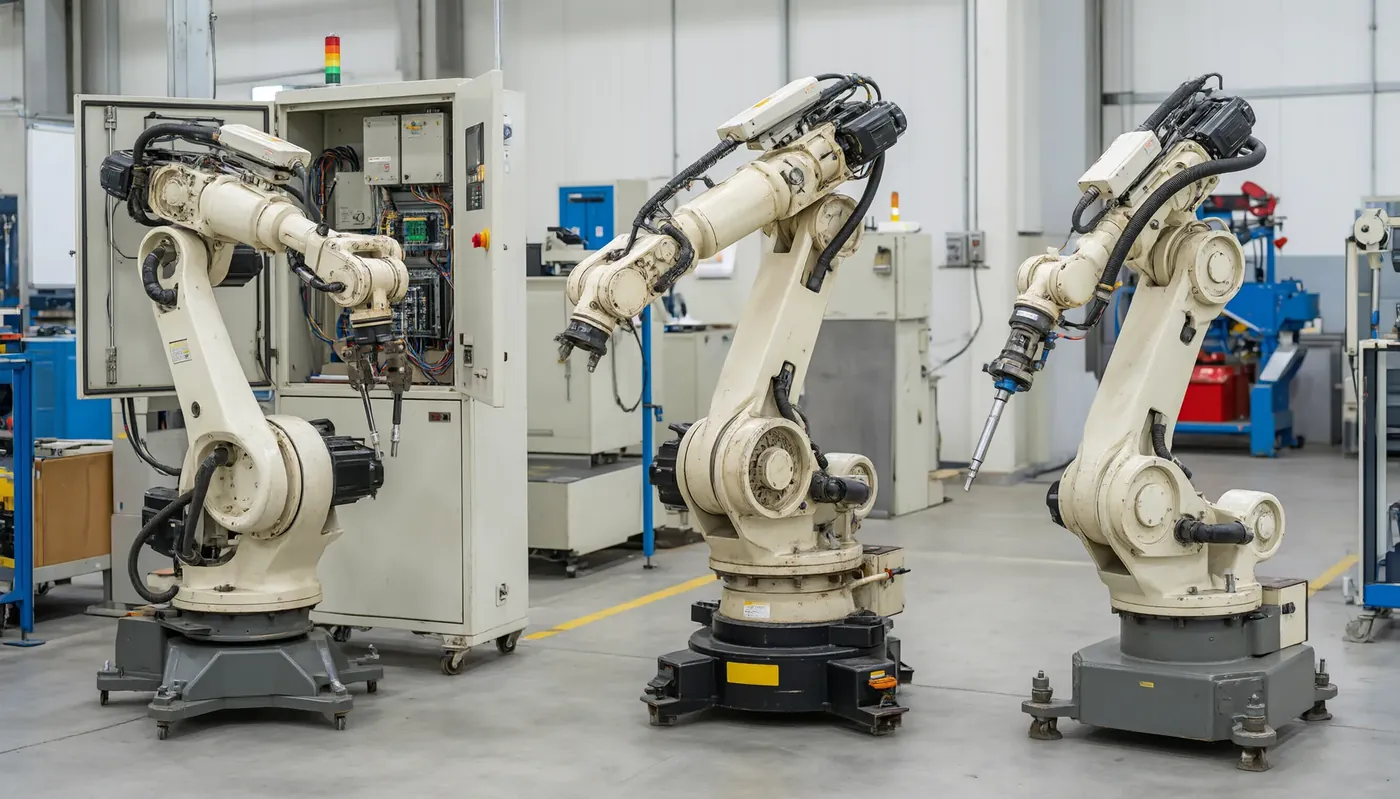
Where does the equipment come from?
The biggest fear for second-hand robots is their unknown origin. Our equipment mainly comes from four types of channels: First, factory production line upgrades, where existing robots with good performance but increased process requirements have been replaced; Second, idle equipment after enterprise relocation, production reduction, or production line relocation; Third, equipment transferred in bulk by the asset disposal party at the time of closure liquidation; Fourth, self-owned equipment recovered after lease expiration. For each unit, we require a source description and equipment number, verify the model and factory serial number on the nameplate to prevent patchwork units, accident-damaged units, and units under undisclosed liens from entering the market. The equipment number is written into the sales contract and inspection report, ensuring traceability of the source—this is both the buyer's guarantee and our own risk control bottom line.
Checklist for each warehouse inspection item
After the equipment is stored, it is not immediately shelved but first goes through the complete inspection process. Inspection of appearance and mechanical parts: Check for impact deformation of the body, condition of paint and castings, check for leakage in shaft seals, reducer oil level and quality, and check if balance cylinder pressure is normal; Motion section inspection: manually operate each axis for full-stroke operation, listen for abnormal noise, binding, or crawling, measure backlash and repeatability of each shaft; Electrical section inspection: controller power-on self-check to see if it passes, alarm history records for major faults, servo motor three-phase current and insulation, encoder feedback stability, teach pendant buttons and touch functions, I/O and communication ports; Safety inspection: Emergency stop circuit, safety door signals, soft and hard limits, and whether the brake action is reliable. Items that pass inspection proceed to the refurbishment stage; those that do not pass are directly returned or dismantled as spare parts, and are never mixed into the complete machine sales. The table below shows the specific test items and criteria.
Color grading and refurbishment standards
We classify used robots into three levels: A, B, and C based on actual test conditions. The grading results are recorded in the inspection report, and the price is directly linked to the warranty period. Class A refers to equipment with a short usage time, meeting accuracy standards, and basically undamaged appearance. Refurbishment mainly involves cleaning and maintenance and functional retesting; Grade B refers to equipment with long usage time or localized wear but in good condition of core components, which will have seals, cables, and wear bearings replaced and repainted; Class C refers to equipment that can operate normally but has obvious wear or high cumulative working hours, suitable for handling and palletizing conditions where precision and appearance are not required, offering the greatest price advantage. Regardless of the level, continuous roll-up runs must be completed before delivery; non-compliant units will not be shipped out of the warehouse. Grading is not up to us; the test report includes actual test data, and you can also commission a third party for re-inspection.
What will you get upon delivery?
One complete machine (including the main unit, controller, teach pendant, power cable, and main unit cable), one written inspection report (including actual accuracy measurement data for each axis, alarm history, replacement parts list), one warranty card, and a brief operation and maintenance description. If installation commissioning, program instruction, operator training, or lifting are required, these are optional and should be separately specified in the contract for costs and responsibilities. Before the equipment leaves the factory, we record the zero marks, axle posture, and wiring markings and photograph them for archiving. When installed on site, you can directly reset them to reduce on-site commissioning time. It should be noted that second-hand robots usually do not include the original process program or fixtures. Program development requires reteaching based on your actual workpiece, which we can take on separately.
The real trade-off between second-hand and new machines
We don't shy away from this comparison, because choosing the wrong one is the biggest waste. The advantages of the new machine include: OEM warranty on the entire machine, full VAT invoice issued, the latest controller platform and optional features can be specified, and it is suitable for projects that need to be counted as fixed assets or apply for technical upgrade subsidies. The advantages of used robots are: prices usually only a fraction of new ones, in-stock can be delivered quickly, discontinued older models can only be replenished through second-hand channels, and for handling and palletizing tasks where precision is not strictly demanding, overperforming new machines are not cost-effective. Conversely, used robots have real shortcomings: warranty periods are shorter than new machines, cumulative working hours determine the remaining lifespan, spare parts rely on the dismantled parts market, and manufacturers cannot enjoy free software upgrades and training. Our recommendation is to select based on working conditions: high-precision assembly, welding, gluing, and other workstations that require high repeatability and trajectory stability, prioritizing new machines or second-hand Class A; For tasks like loading and unloading, palletizing, and handling, B-grade second-hand offers better value for money.
| Level | Actual test status | Revamp content | Applicable working conditions | Warranty period |
|---|---|---|---|---|
| Grade A | Short usage time, repeated positioning accuracy on all axes meets standards, appearance is basically undamaged, and alarm history has no major records | Cleaning and maintenance, oil changes and fat replenishment, functional retesting, accuracy calibration | Welding, assembly, gluing, precision loading and unloading | 6 months |
| Grade B | If the usage period is long or there is localized wear, the core components are in good condition and the accuracy is within tolerance ranges | Replace seals and cables, wear bearings, patch up local paint, and recalibrate | Palletizing, handling, general loading and unloading, machine tool loading and unloading | 3 months |
| C grade | It can operate normally, with obvious wear or high cumulative working hours, resulting in reduced accuracy | Safety inspections, necessary maintenance, functional tests, no exterior refurbishment | Rough handling, low-cycle workstations, backup machines, teaching and practical training | 1 month |
| Spare parts machine | The whole machine does not meet the standards, but some components are usable | Disassembled into spare parts such as servo motors, reducers, and boards | Source of spare parts for maintenance | According to the spare parts terms |
Service process
From requirement integration to delivery and archiving, every step has clear outputs, without relying on verbal agreements.
-
01
Communication of requirements
Inform us of your application scenarios (welding, handling, palletizing, assembly, spraying, etc.), workpiece weight, required arm reach, cycle requirements, and budget range, and we will match the machine accordingly.
-
02
Model matching and pricing
Selecting eligible models from the inventory of equipment, providing detailed parameters, real photos, inspection reports, and condition grading, along with price and warranty terms, are then reported.
-
03
Machine Inspection (supports on-site or video recording)
We demonstrate the operating status of the equipment item by item according to the inspection checklist, including full-range actions for each axis, alarm history queries, and actual accuracy measurements. You can visit in person or remotely video inspect the device.
-
04
Sign contracts and make payments
The contract specifies the equipment model, serial number, color grade, configuration list, warranty scope, delivery method, and acceptance standards. The terms of payment and invoice are clearly specified in the contract.
-
05
Renovation and outbound review
Refurbishment, cleaning, repainting, and functional retesting are completed according to the agreed grade. After continuous operation and passing inspection, the machine is packed and shipped out of the warehouse, accompanied by a test report and warranty card.
-
06
Delivery and after-sales tracking
Logistics or self-pickup are arranged, with optional on-site installation, commissioning, and operational training. If faults occur within the agreed scope during the warranty period, they will be handled free of charge according to the contract.
This service covers brands and industries
Click to enter the brand page to view model specifications, or view application solutions by industry.
 FANUC
FANUC ABB
ABB YASKAWA
 KAWASAKI
 KUKA
KUKA INOVANCE
 ESTUN
ESTUN STÄUBLI
 Universal Robots
 Epson
Epson NACHI
NACHI COMAU
COMAU SIASUN
 EFORT
EFORT GSK
GSK JAKA
JAKA AUBO
AUBO TOPSTAR
 HSR ROBOT
 QJAR
QJAR Panasonic
Frequently Asked Questions
For the most frequently asked questions from customers, try to be realistic and avoid vague promises.
What is the approximate price of a used robot?
There is no fixed price for used robots; prices are determined by brand, model, load, arm reach, color grade, total working hours, controller generation, and whether installation and commissioning are included, and they fluctuate with market supply and demand. We do not offer "fixed price" pricing, but instead quote each unit based on the specific equipment in stock. If you tell us the operating conditions and budget, we'll screen the model first and then negotiate the price, which is more efficient than asking for a general price first.
Can invoices be issued?
Invoices can be issued. The specific invoice type and tax rate depend on the nature of our transaction with you and the contractual agreement. We will clarify this before signing, and there is no situation where we are notified only after the transaction cannot be issued. If a special invoice needs to be used for offsetting or being included in fixed assets, please specify this in advance during the requirement communication.
How can you confirm that the device is not an accident machine or an assembly machine?
Three checkpoints: First, verify the model and factory serial number of the nameplate on the fuselage, and compare it with the system information recorded in the controller; Second, check alarm history; major collisions, overloads, and encoder abnormalities can leave traces; Third, open the body to inspect the internal structure; traces of accident repair cannot be hidden on the casting, seals, or reducer mounting surfaces. All three items will be included in the inspection report, so you can check each item when you come to the site for inspection.
Can I take the machine back for trial first?
Contractless trial use is generally not supported, for practical reasons: the cost of robot handling and installation is high, the repeated operation damages equipment, and responsibility is hard to define. But I suggest you take another path—first rent equipment of the same model daily or monthly, run a real cycle on the production line, verify the beat and stability, and then decide whether to buy. Our rental plan supports rent-to-purchase, where paid rent can be used to offset the purchase price, which is more practical than "trying it out."
How many more years can second-hand robots be used?
The design lifespan of industrial robots generally exceeds tens of thousands of working hours, and the actual remaining lifespan mainly depends on cumulative operating hours, operating load rate, and maintenance level rather than natural lifespan. A well-maintained ten-year-old machine with low cumulative hours may be in better condition than a machine in poor condition that has run at full load for three years. We will provide the total working hours and test data truthfully, so you can judge for yourself without evasive explanations.
What if you don't know how to use it after buying it?
Getting the robot body in place is only the first step; to truly be usable, it requires five tasks: installation and fixing, wiring and power-on, zero calibration, process teaching, and integration with surrounding equipment. We offer on-site installation, commissioning, and operational training services, and can also directly undertake process program development, teaching according to your workpiece and actual rhythm. This part is optional service, priced separately in the contract and not vaguely packaged into "home delivery."
Who is responsible for equipment damage during transportation?
Transportation responsibilities are clearly defined in the contract. For logistics arranged by us, any damage during transportation will be borne by us and responsible for repair or replacement; If you pick up or find your own logistics, the risk will shift from the time of delivery. Regardless of the method, before the equipment leaves the warehouse, we will take photos for archiving and ensure proper securing and protection. Please inspect and sign for the equipment on the spot upon delivery, and record any issues found.
Can you still buy discontinued old models?
Yes, this is precisely the irreplaceable value of the second-hand robot market. Manufacturer shutdowns mean the new device channel is cut off, but existing equipment is still circulating, and the dismantled parts market can support subsequent maintenance. Among the more than 1,000 models from ten mainstream brands we cover, a significant proportion are discontinued generation models, suitable as supplementary machines or spare parts for existing production lines.
Need business cooperation?
Feel free to contact us to explain your specific scenario and needs, and we will communicate and coordinate with you in a timely manner.
Contact us immediately