
Palletizing robots
Automatic stacking and depalletizing of finished boxes, bags, and barrels—mainstream is four-axis dedicated heavy-load robotic arms (manipulators), the most widely used category of robots in the food and beverage, grain and oil chemical, and logistics industries. This page provides a detailed explanation of its system configuration, selection parameters, and common issues, along with an index of the 61 models in our database.
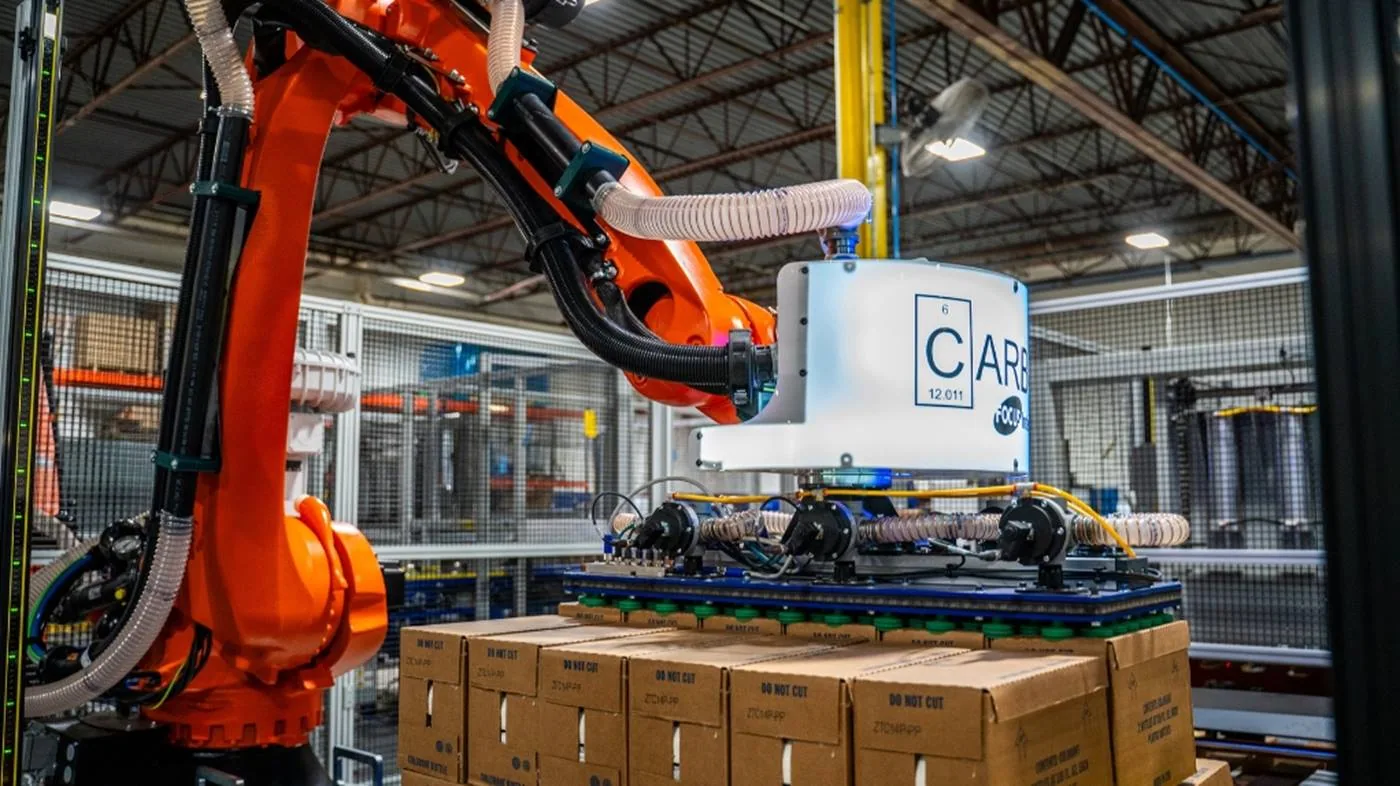
Palletizing robots: structurally, they are mostly four-axis dedicated robotic arms
What is a palletizing robot?
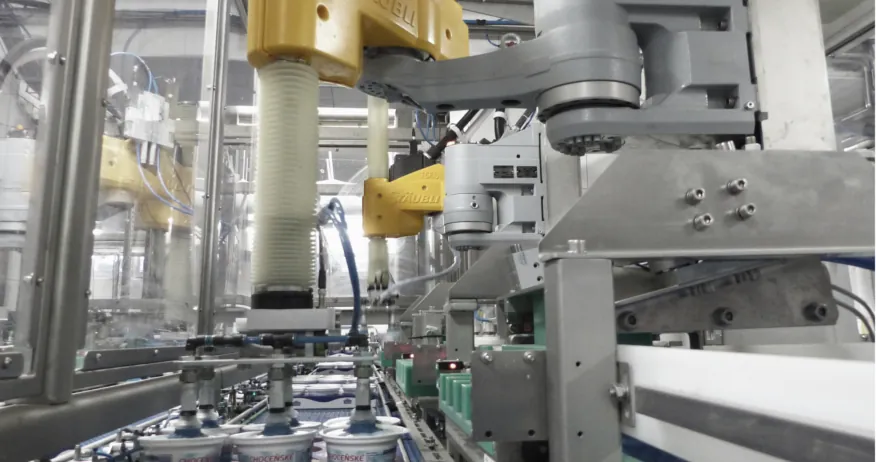
Palletizing robots (customers often search for "palletizing robotic arm" or "palletizing manipulator") are industrial handling robots classified by function, responsible for neatly stacking finished products such as boxes, bags, buckets, and bags onto pallets according to palletizing rules, or removing them from the stacks (depalletizing). It is one of the most widely used robot categories in the food and beverage, grain and oil, chemical, building materials, and logistics industries.
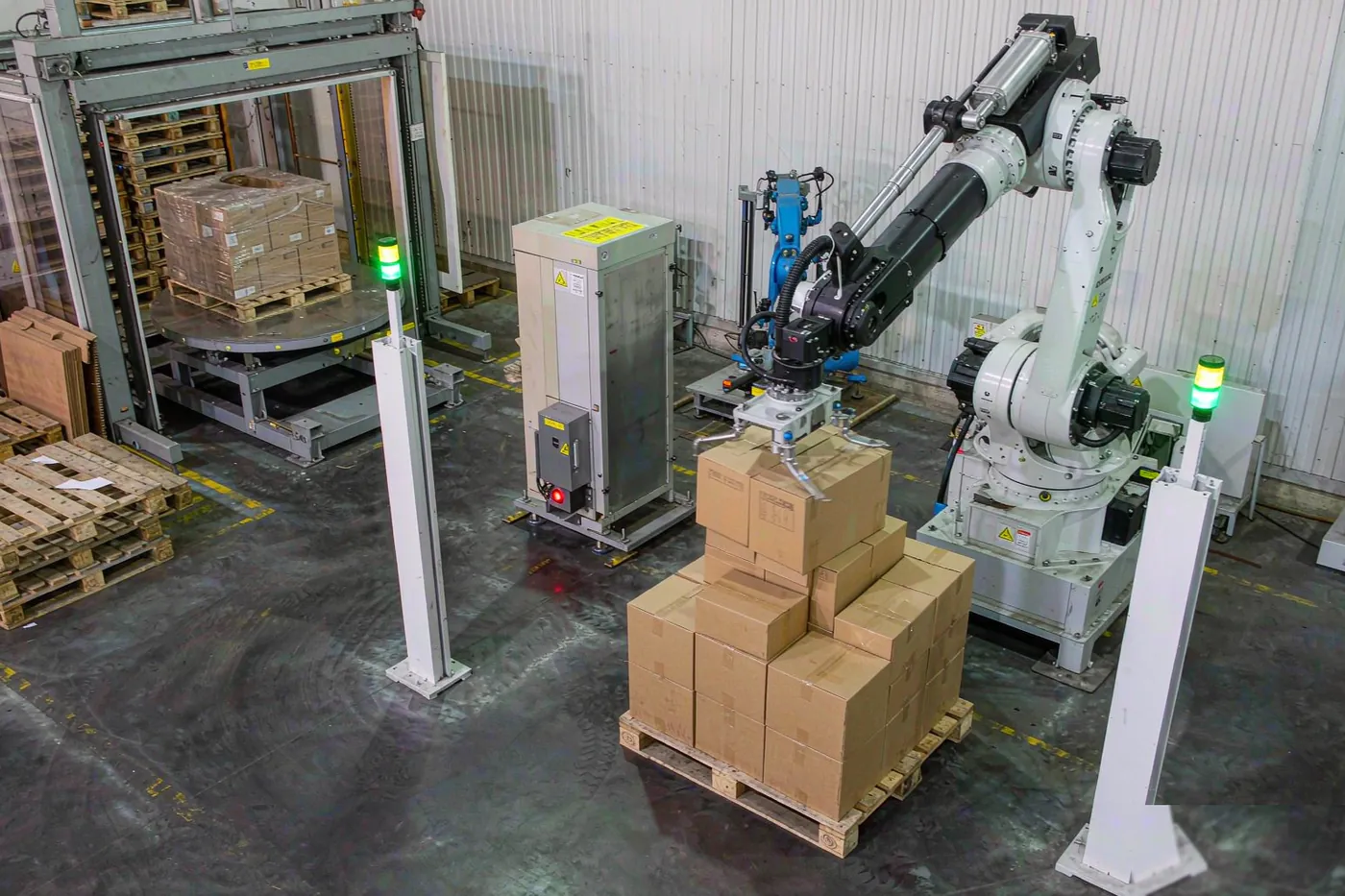
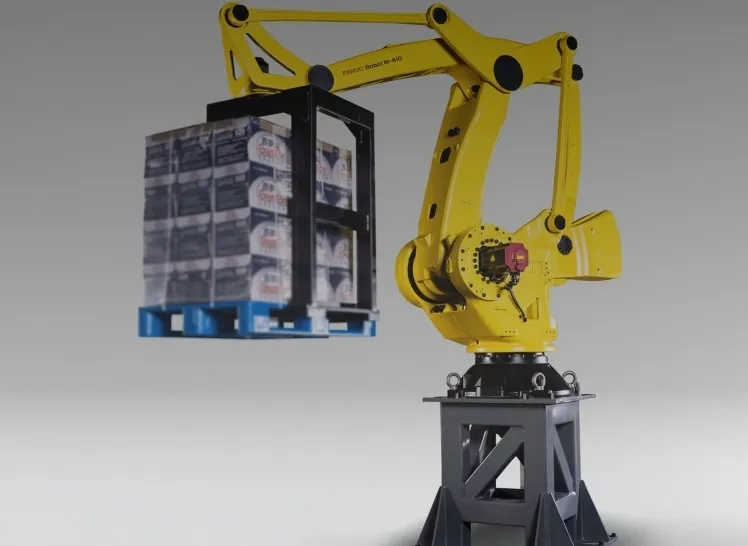
Structurally, palletizing robots have a distinctive feature:The mainstream is the four-axis dedicated robotic arm— Three joints for spatial positioning + a rotating shaft at the end to adjust the orientation of the box, eliminating the need for two flip shafts on the six-axis wrist. Why? Because the palletizing action is mainly about picking, putting, and shifting, with almost no need for flipping posture, the four axes gainHigher speed, heavier payload, longer reach, lower cost, and fewer failure points。 Brands such as PAL/PL/RMD/M-410 belong to this category; Heavy-duty palletizing (grain and oil bags, building materials) with loads over 100kg is almost entirely four-axle.
One set of palletizing units = Robot body + palletizing fixtures (suction cups/clamps/grippers) + feed conveying and sorting + pallet warehouse (for empty pallets) + palletizing software + safety fence。 Among themStack-type programIt's the soul: the same box, but the stability and space utilization of the staggered stacks are completely different.
| Pattern | Movement characteristics | Technical Points |
|---|---|---|
| Palletizing | Stack according to the stacking pattern rules onto pallets | Pallet type algorithms, inter-floor joint pressing, and pallet height detection |
| Depalletizing | Remove the box from the stack layer by layer | Visual/laser positioning stack layer, vacuum suction cup belt protection box |
| Mixed-SKU | Boxes of different specifications are stacked together on one pallet | 3D visual recognition + online palletizing calculation, cutting-edge e-commerce logistics |
Key points for selecting palletizing robots
| Parameters | Typical range | Project description |
|---|---|---|
| Load | 50–700kg (mainstream 100–300kg) | Load = box weight × number of picks per pass + fixture self-weight; Bagged materials need to be measured by impact coefficient |
| Armspan | 2000–3300mm | Coverage: feed point + pallet position + (optional) empty pallet warehouse, with heavy load palletizing generally having a large reach |
| Number of axles | 4. Axes (specialized) are the main focus | Four-axle = high-speed, heavy-load economical choice; For cases requiring the case to be flipped or in complex postures, choose six-axis |
| Beat | 600–2000 cases per hour | Suction cup type is the fastest; The splint type is slightly slower but suitable for soft packaging such as woven bags |
| Stack height | Common is 1.8–2.4 meters | For high stacks, check the reachable posture of the arm reach + fixture on the highest level |
| Types of fixtures | Vacuum suction cup/clamp/mechanical gripper/modular type | Carton → suction cups; Woven bags → plywood; Barrel-→ clamps; Multi-category → quick exchange |
| Protection rating | IP65–IP67 | Essential for washing away grain and oil dust, and beverages; Flour/starch dust requires explosion-proof assessment |
Six-axis robotic arms can also be palletized—when should you choose six-axis?
Load ≤ 50kg, requiredCabinet flipping(such as label orientation), multiple stations in one machine (palletizing + packing + labeling), or when flexible layout is required due to space constraints, the six-axis robotic arm is a better choice; Collaborative robotic arm + suction cup for light-load palletizing (≤20kg) has also rapidly become popular at the end of production lines in recent years. Pure palletizing, heavy load, high cycle — four-axis dedicated machines are still more professional.
The palletizing system covers eight major business areas
What can we do for you?
Applied technology services: Palletizing workstation solution design, palletizing program development, fixture selection and manufacturing, conveyor line integration—see detailsPalletizing applications。
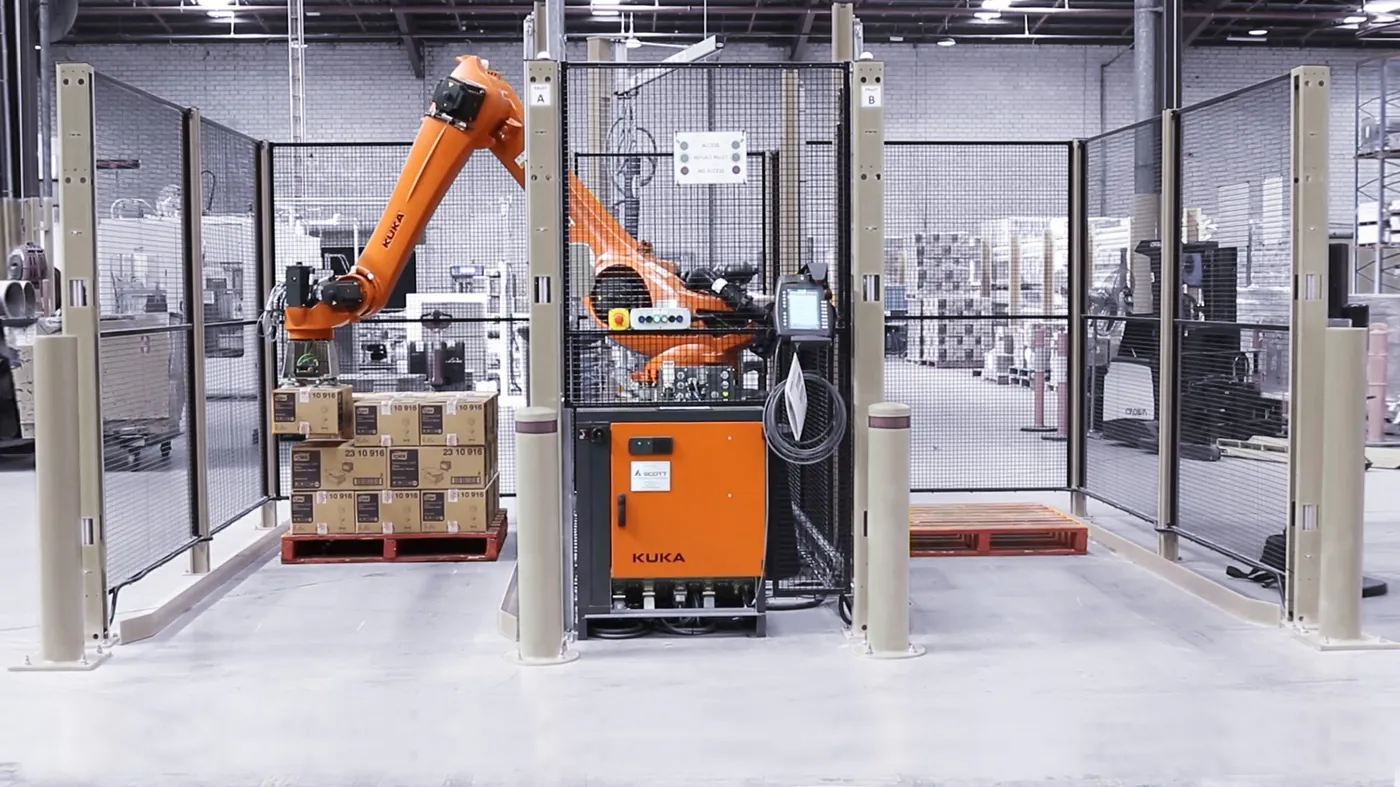
New and second-hand machine sales: Mainstream palletizer models such as ABB IRB 460/660/760, FANUC M-410iC, Yaskawa MPL/PL series, Kawasaki RD, KUKA KR 40 PA are available in stock and used, with load test reports attached.
Maintenance and repair: Common palletizing condition issues—inspection and maintenance of large boom structures, gear reducer wear, suction cup vacuum leakage, and air leakage in balance cylinders.
Upgrades and rentals: Install visual error prevention and upgrade palletizing software for old palletizers; Heavy-duty palletizers can be leased short-term for peak season capacity fluctuations.
Frequently Asked Questions
Is a palletizing robot a robotic arm?
It is—and one of the most typical "large robotic arms": a four-axis articulated structure, shaped like a large robotic arm. Customers searching for "palletizing robotic arm" and "palletizing manipulator" is completely correct; it is an industrial robot in the form of a robotic arm.
How many boxes can a palletizing robot stack in one hour?
Depending on box weight, stacking type, and feeding cycle: Suction cup palletizing cartons typically hold 800–1500 cartons per hour, bagged materials (50kg woven bags) about 400–700 bags per hour, and heavy-load drums about 200–400 barrels per hour. When the feeding can't keep up, no matter how fast the robot is, it's useless—matching the beat time across the entire line is key, and we calculate this when we come up with a solution.
What are the special requirements for palletizing bagged materials (flour/fertilizer)?
Three Key Points: (1)Fixtures— For woven bag soft wrapping, use clamp or combination clamps; pure suction cups tend to leak air and fall off; ②Explosion-proof— For combustible dust environments involving flour and starch combustible dust, select and design explosion-proof equipment (explosion-proof motor/positive pressure cabinet) according to dust explosion-proof standards; ③Dustproof——IP67 protection + joint sealing ring reinforcement, preventing dust from entering the reducer significantly shortens lifespan.
How to choose a used palletizing robot without pitfalls?
Focus on four key points: (1) Reducer backlash (large boom heavy-load structures wear out quickly, with load testing accuracy in place); (2) Balance cylinder/counterweight system (air and oil leaks directly affect the arm's retention capability); (3) Check whether the metal structure has cracks or traces of welding; (4) Controller and software authorization (whether stack-type software is included). All used robots we sell come with these four specialized test reports.
This site offers palletizing robots in warehouses (61 models)
Browse by brand
Below are representative models in this functional category in our database (matched by process label, cross-structural form). Click to view specifications, technical explanations, and maintenance points. For the complete model list, please see each brand's page.
ABB (2 styles)
KUKA (17 models)
Kawasaki (6 models)
Nachi Fubietsu (4 models)
Comau (3 models)
Universal Robots (2 styles)
Inovance Technology (6 models)
Estun (4 models)
Guangzhou CNC (8 models)
HSR Robotics (1 model)
QJAR Robotics (8 models)
Need robot selection, maintenance, or application solutions?
Tell us about workpieces, procedures, beats, and budgets. Local teams in Nanchong will connect with us, and on-site inspections are available in Sichuan, Chongqing, Yunnan, and Guizhou. Robotic arm (manipulator) selection, second-hand purchase and sale, maintenance and repair all in one place.
Contact usView all varieties