
Maintenance and repair
On-site inspection, fault diagnosis and maintenance, programming, commissioning, and teaching of industrial robots, covering mainstream market brand models.
For every day a robot is shut down, the production line loses output by one day. We prioritize repair response speed and technical transparency: inspect first, quote later, and repair afterward—every step is recorded.
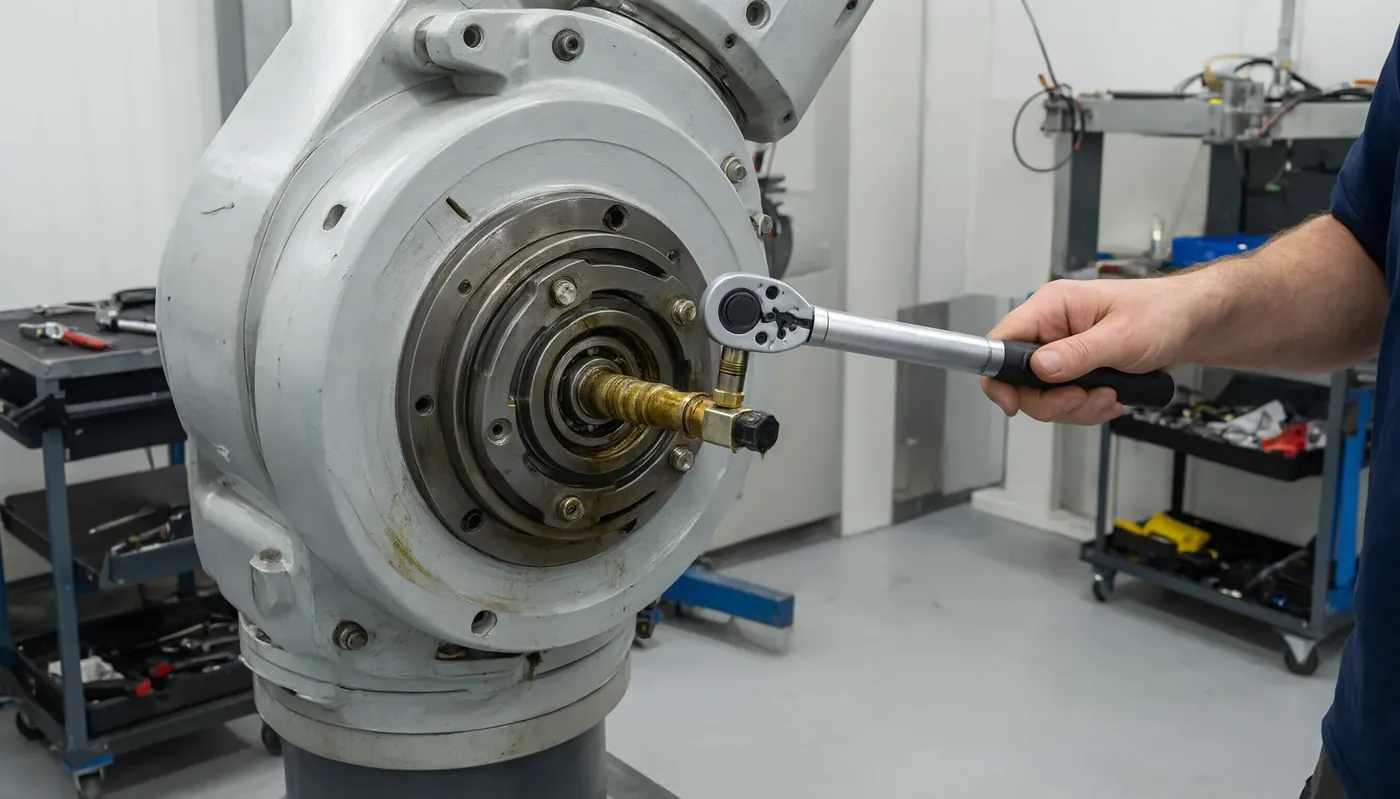
What faults can we handle?
When an industrial robot shuts down, it's usually not the whole machine being scrapped, but rather a component failing. We categorize faults into four main categories: electrical, mechanical, control, and communication, each item checked: electrical includes servo motor abnormal noises or overheating, encoder alarms, driver overcurrent or overvoltage, main body cable wear and breakage, grounding and leakage; Mechanical issues include reducer oil leaks or excessive clearance, bearing wear on each shaft, abnormal gearbox noises, air leakage or pressure degradation in the balancing cylinder, and dust ingress due to aging seals of the body; Control types include controllers failing to power on, persistent alarm codes that cannot be cleared, black screens or button failures of the teach pendant, and system battery depletion leading to loss of zero position; Communication includes signal interruptions with PLCs, vision systems, and host computers, unresponsive I/O points, and bus communication errors. Whether it's FANUC, ABB, Yaskawa, Kawasaki, KUKA, or Inovance, Estun, Epson, Stäubli, and Universal, we can independently handle common faults from mainstream brands.
Electrical and drive system failures
Servo systems are the part of the robot with the highest failure rate. Common symptoms include: abnormal noise or abnormal temperature rise during motor operation (mostly bearing wear or brake pad wear), encoder alarms (encoder body or feedback cable faults), driver overcurrent or overload (mechanical jamming causing sudden load increase or power module aging), severe overheating of brake resistors (brake unit failure or parameter drift). We bring servo motors, encoders, and feedback lines of the same specifications to the site for replacement verification, quickly distinguishing whether the issue is with the motor body, driver, or mechanical load, and to avoid mistaken replacement errors. Common faults on the controller side include: fan shutdown causing alarms of excessive cabinet temperature, low mainboard battery voltage causing loss of program or zero point, power module damage causing power-on failure, and I/O board channel burnout. For board-level repairs, we replace components and conduct functional tests, avoiding blind replacement of entire boards.
Mechanical and drivetrain system failures
Mechanical failures are often progressive, initially manifesting as reduced accuracy, trajectory shifts, or end shaking. The reducer is a core component: RV reducers (Nabtesco RV-E, RV-C and other series) are commonly found on heavy-load shafts, with faults such as oil leakage, excessive backlash, and low-speed crawling; Harmonic reducers (Harmonic Drive SHF, CSF series, etc.) are mostly used for low-load shafts and SCARA, with faults manifesting as flexible pulley fatigue fracture and output shaking. Wear of bearings on each shaft can cause axial movement and abnormal noises, so it is necessary to disassemble and inspect them before measuring the clearance. The balancing cylinder (spring cylinder or pneumatic-hydraulic cylinder) is used to offset the weight of the boom. When leakage or insufficient pressure occurs, the robot will slide down or operate under significantly higher motor load. Additionally, aging of the main sealing ring can lead to the intrusion of cutting fluid, dust, and moisture, which over time can progressively damage the reducer and wiring harness. In such cases, we handle both sealing and internal cleaning, rather than just replacing the parts.
Typical alarm codes and preliminary judgments
Different brands have different alarm systems, but there are common patterns. FANUC's SRVO-series alarms point to servo and encoder faults (such as SRVO-038 pulse encoder data anomaly, SRVO-062 BZAL loss of zero position), SYST-series alarms relate to the system and safety circuits; ABB's 38xxx series is often associated with serial measurement board SMBs and their batteries, while the 10xxx series is often associated with motion monitoring and safety chains; YASKAWA's 4xxx type alarms mostly point to servo drivers and encoders, accompanied by detailed subcodes on the teach pendant; KUKA (KUKA) KR C4/KR C5 controllers provide textual information prompts, commonly including acceleration monitoring, soft limit triggering, and safety circuit disconnection. Our approach is: first check the alarm code to lock the direction, then check historical alarm records and operation logs to determine whether the fault is sudden or cumulative, and finally use the replacement method or instruments to measure and locate the specific component, rather than replacing the most expensive part on the strength of a code alone. It should be emphasized that the same code may have completely different causes under different operating conditions; the final conclusion should be based on on-site inspection.
Covering brands and models
We have handled over a thousand models from ten major mainstream brands, including FANUC's LR Mate series, M-710iC/M-900iB series, R-2000iC series, and ARC Mate and CR collaboration series; ABB's IRB 1200, IRB 1600, IRB 4600, IRB 6700, and YuMi collaboration series; Yaskawa's GP series, MH series, and Motoman models; Kawasaki's RS, BX, CX series; KUKA's KR AGILUS, KR QUANTEC, KR FORTEC series; as well as series from Inovance, Estun, Epson, Stäubli, and Universal Robots. The controller platform covers mainstream generations such as FANUC R-30iB/R-30iB Mate Plus/R-50iA, ABB IRC5/OmniCore, Yaskawa DX200/YRC1000, and KUKA KR C4/KR C5. For discontinued older models, we ensure repairability through three paths: disassembling parts, compatible parts, and board-level repairs, rather than simply telling customers "the manufacturer is no longer supplying."
| Fault location | A typical phenomenon | Detection methods | Handling methods |
|---|---|---|---|
| Servo motor | Abnormal noises, overheating, encoder alarms, low insulation | Megohmmeter measures insulation, clamp meter measures three-phase current, and abnormal sounds are detected by auscultation | Replace bearings / replace encoders / rewind / replace entire machines |
| RV reducer | Oil leakage, excessive backlash, and low-speed crawling | Laser interferometer or dial meter to measure repeatability and clearance measurement | Oil change and grease replenishment / Preload adjustment / Reducer replacement |
| Harmonic reducer | Output shaking, flexible wheel breakage, periodic abnormal noises | Disassemble and inspect the meshing surfaces of the flexible and rigid wheels, and measure output torque fluctuations | Replace the harmonic reducer and recalibrate the zero point |
| Controller motherboard / power supply | Unable to power on, repeatedly restarting, or alarms failing to clear the issue | Voltage tests for each channel and replacement methods to verify the board | Board-level component replacement / board replacement / power module replacement |
| Demonstrate the teaching device | Black screen, touch offset, button malfunction, cable breakage | Replace the cable and the main unit by segment | Screen replacement / button film replacement / cable replacement / entire device replacement |
| Main body wiring harness | Signals are intermittent, shielding layer is damaged, and interference errors occur | Multimeter continuity testing and oscillation method for locating breakpoints | Partial repair / full bundle replacement (original or compatible) |
| Balance cylinder / spring cylinder | Power outages lead to slippage, overloaded load, and leak noise | Measure nitrogen pressure, check seals and cylinder walls | Replace seals / refill with nitrogen / replace the entire unit |
| Zero point and encoder battery | Zero loss alarms (such as BZAL, SMB low battery) | Read the battery voltage and check the zero marker position | After replacing the battery, recalibrate and retest the accuracy |
Service process
From requirement integration to delivery and archiving, every step has clear outputs, without relying on verbal agreements.
-
01
Fault repair and information collection
You provide the robot brand, model, controller model, alarm code, or fault description of the phenomenon. If possible, record a video of the teach pendant's alarm screen and the fault location. The more complete the information, the more accurate the initial judgment.
-
02
Remote initial assessment and plan communication
Engineers make a preliminary judgment based on the alarm code and phenomena, informing them of the likely fault range, the tools and spare parts to bring, and the on-site delivery time. This step is free of charge.
-
03
On-site inspection and fault localization
After arriving at the factory, first use a diagnostic device to read the alarm history and operation log, then measure item by item: motor insulation and three-phase balance, encoder feedback, reducer reverse backlash, load current for each shaft, air circuit and sealing status, and disassemble and inspect if necessary.
-
04
Inspection report and quotation confirmation
Output written inspection results, specifying the fault location, cause analysis, optional repair plans (replacement for new parts/board-level repairs/disassembled parts replacement), as well as their respective costs and warranty periods. We will only proceed after you confirm the plan.
-
05
Maintenance implementation and functional testing
After replacing parts, perform zero point calibration, no-load and load operation tests for each axis, retest repeatability, verify safety circuits and emergency stops, and perform continuous operation and machine testing. Only after confirming compliance is the equipment is delivered.
-
06
Delivery archiving and warranty tracking
Provide maintenance records and replacement parts lists, and include them in equipment archives. If the same fault occurs during the warranty period, free repair; if not the same fault, priority is also provided.
This service covers brands and industries
Click to enter the brand page to view model specifications, or view application solutions by industry.
 FANUC
FANUC ABB
ABB YASKAWA
 KAWASAKI
 KUKA
KUKA INOVANCE
 ESTUN
ESTUN STÄUBLI
 Universal Robots
 Epson
Epson NACHI
NACHI COMAU
COMAU SIASUN
 EFORT
EFORT GSK
GSK JAKA
JAKA AUBO
AUBO TOPSTAR
 HSR ROBOT
 QJAR
QJAR Panasonic
Frequently Asked Questions
For the most frequently asked questions from customers, try to be realistic and avoid vague promises.
If the robot suddenly stops, what is the fastest time it can reach the site?
We first conduct a remote preliminary assessment, confirm the scope of the fault, and then arrange for engineers to carry the corresponding spare parts to avoid wasted trips and repeated trips. The arrival time depends on your location and the engineer's schedule at the time. The specific delivery time is confirmed in person during the repair request and written into the repair order. In Sichuan and Chongqing, we can arrange same-day or next-day arrivals; for Yunnan-Guizhou, arrangements are made based on traffic conditions.
Is there a fee for on-site testing? What if it wasn't repaired in the end?
Remote initial assessment is free of charge. If on-site inspection is required, we inspect first, then quote, and repair afterwards; If you decide not to repair after reading the quote, only the testing and outpatient fees will be charged, with no repair fees charged. The quotation sheet will specify the source of each fee; there is no case of repairing before quoting.
How long is the typical repair cycle?
Most common electrical faults (replacing servo motors, encoders, or battery zero calibration) can be completed on the same day of arrival. For mechanical parts that require disassembly and replacement of reducers and bearings, it usually takes several days, depending on whether spare parts are in stock, whether lifting and precision retesting are needed. Disassembled parts for discontinued models may require reshipment. The specific timeline is communicated with the quotation after the inspection is completed, not a random figure.
Should you use original parts or aftermarket parts for accessories?
Both are available, and you can choose from them. Original parts are expensive, have long delivery times, but come with manufacturer warranties; Quality: Compatible parts are priced low and available quickly, and we also take responsibility for warranty on compatible parts. We will indicate the source and warranty period of each component on the quotation sheet, and will not pass off inferior products without your knowledge. For safety-related components, we recommend using original parts.
How long is the warranty period after repairs?
Replaced new parts and repair parts usually come with a 3 to 6 month warranty, with the specific period specified on the repair order depending on the component type and plan. If the same fault reappears during the warranty period, free repair; Damage caused by human error, external impact, or over-specification use is not covered by the warranty; we will clarify this upon delivery.
Our factory has several brands of robots. Can you all repair them?
Yes, you can. We cover mainstream brands such as FANUC, ABB, Yaskawa, Kawasaki, KUKA, Inovance, Estun, Epson, Stäubli, and Universal, without brand authorization restrictions or OEM after-sales coverage limits. Multi-brand mixed-line workshops are actually better suited for unified maintenance by third-party service providers, with spare parts and records centrally managed.
What should you do if the robot loses Zero Point? Can it recover on its own?
Zero loss is usually caused by the encoder's backup battery voltage being depleted. If the device has performed zero-point backup and the machinery has not been disassembled, the battery can be restored directly after replacing the battery according to the standard procedure; If the mechanical part has been disassembled or not backed up, special tools must be used to reteach the zero point. This step greatly affects accuracy, so inexperienced on-site personnel are not recommended to operate it themselves. Incorrect zeroing can cause trajectory deviation or even collisions.
The model has already been discontinued, and the manufacturer says there are no spare parts left. Can it still be repaired?
In most cases, yes. There are three solutions for older models: first, dismantle parts—remove parts of the same model from retired equipment, test them before use; Second, board-level repair, which involves component-level replacement of damaged circuit boards; Third, compatibility substitution, where general components with matching parameters are used for adaptation and commissioning. We will specify in the quotation which route is used and the corresponding difference in warranty period.
Can annual maintenance contracts be signed?
Yes, you can. Annual maintenance is suitable for enterprises with a large number of robots or whose production lines cannot be shut down for extended periods. It includes regular inspections, preventive replacement of consumable parts, precision retesting, priority response to emergency faults, and equipment archive management. Maintenance plans are customized according to equipment quantity, model, operating duration, and response level, requiring on-site inspection before quoting.
Is the entire line required to stop during maintenance?
Depending on the position of the faulty robot on the production line and the redundancy of workstations. For a single robot maintenance, it usually only needs to isolate the workstation and set up safety barriers, without requiring a full shutdown. We will confirm with you in advance the shutdown window, try to schedule it during shift changes, weekends, or scheduled maintenance periods, and specify the specific steps requiring power outage, gas outage, and hoisting coordination in the maintenance plan.
Need business cooperation?
Feel free to contact us to explain your specific scenario and needs, and we will communicate and coordinate with you in a timely manner.
Contact us immediately