The global leader in industrial robotics — YASKAWA MOTOMAN, the full range
Covering arc welding, spot welding, handling, palletizing, spraying, human-machine collaboration, and biomedical applications, with payloads ranging from 0.5kg to 800kg.
MOTOMAN robot family
Yaskawa offers a complete automation ecosystem from servos and controllers to industrial robots, branded under the MOTOMAN brand, covering loads from 0.5kg to 800kg.
Load capacity of 4–600kg, high speed and high precision, suitable for assembly, loading/unloading, and sorting.
Specialized for arc welding and spot welding, covering automotive body welding and metal processing.
4–5 axes, 80–800kg load, high-rigidity heavy-duty palletizing.
Explosion-proof design, suitable for automotive and industrial spraying.
Human-machine collaboration, 7-axis and dual-wrist 15-axis support, and force-sensing safe interaction.
Product series and specifications
The following specifications are compiled from public information on the official Yaskawa website (load, reach, footprint, body weight) for model selection and comparison.
GP series
Universal handling / assembly / loading and unloading, full coverage with loads from 4kg to 600kg, YRC1000 control cabinet.
Equipped with Yaskawa's self-developed Σ-7 servo system, it operates swiftly and offers high repeatability.
Supports loads from 0.5kg to 800kg, covering welding, handling, palletizing, spraying, and other scenarios.
High IP protection rating, suitable for harsh working conditions such as dust, oil stains, and humidity.
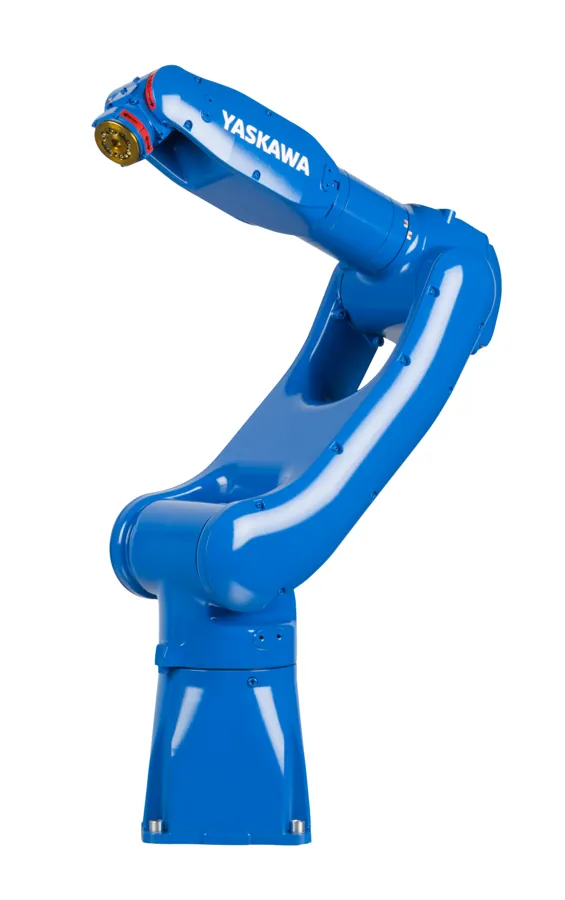
MotoMINI
Ultra-compact 0.5kg desktop-grade robot, suitable for precision assembly and teaching.
Equipped with Yaskawa's self-developed Σ-7 servo system, it operates swiftly and offers high repeatability.
Supports loads from 0.5kg to 800kg, covering welding, handling, palletizing, spraying, and other scenarios.
High IP protection rating, suitable for harsh working conditions such as dust, oil stains, and humidity.
SOC series
SCARA is horizontal multi-joint, high-speed sorting and assembly.
Equipped with Yaskawa's self-developed Σ-7 servo system, it operates swiftly and offers high repeatability.
Supports loads from 0.5kg to 800kg, covering welding, handling, palletizing, spraying, and other scenarios.
High IP protection rating, suitable for harsh working conditions such as dust, oil stains, and humidity.
AR series
Specialized for arc welding, high speed and high precision, supporting various welding processes.
Equipped with Yaskawa's self-developed Σ-7 servo system, it operates swiftly and offers high repeatability.
Supports loads from 0.5kg to 800kg, covering welding, handling, palletizing, spraying, and other scenarios.
High IP protection rating, suitable for harsh working conditions such as dust, oil stains, and humidity.
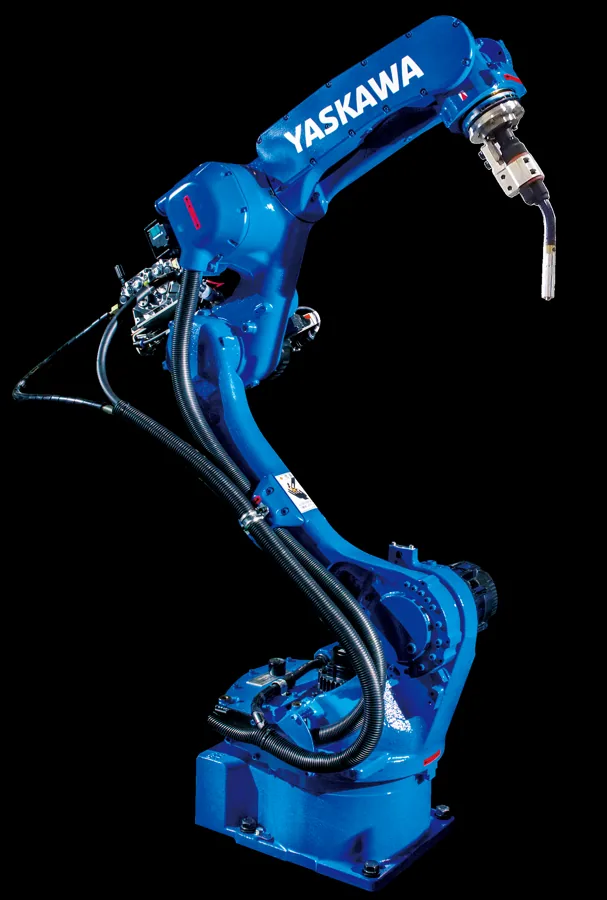
SP series
Spot welding and handling, load capacity 80–235kg, automotive body welding.
Equipped with Yaskawa's self-developed Σ-7 servo system, it operates swiftly and offers high repeatability.
Supports loads from 0.5kg to 800kg, covering welding, handling, palletizing, spraying, and other scenarios.
High IP protection rating, suitable for harsh working conditions such as dust, oil stains, and humidity.
PL series
Dedicated for palletizing, 4–5 axes, load capacity 80–800kg.
Equipped with Yaskawa's self-developed Σ-7 servo system, it operates swiftly and offers high repeatability.
Supports loads from 0.5kg to 800kg, covering welding, handling, palletizing, spraying, and other scenarios.
High IP protection rating, suitable for harsh working conditions such as dust, oil stains, and humidity.
HC series
Human-machine collaboration, force-sensing sensors, safe interaction.
Equipped with Yaskawa's self-developed Σ-7 servo system, it operates swiftly and offers high repeatability.
Supports loads from 0.5kg to 800kg, covering welding, handling, palletizing, spraying, and other scenarios.
High IP protection rating, suitable for harsh working conditions such as dust, oil stains, and humidity.
MPX series
Spray-specific, explosion-proof design.
Equipped with Yaskawa's self-developed Σ-7 servo system, it operates swiftly and offers high repeatability.
Supports loads from 0.5kg to 800kg, covering welding, handling, palletizing, spraying, and other scenarios.
High IP protection rating, suitable for harsh working conditions such as dust, oil stains, and humidity.
MPO Series & MHP45L
Spraying, including MHP45L long-arm type.
Equipped with Yaskawa's self-developed Σ-7 servo system, it operates swiftly and offers high repeatability.
Supports loads from 0.5kg to 800kg, covering welding, handling, palletizing, spraying, and other scenarios.
High IP protection rating, suitable for harsh working conditions such as dust, oil stains, and humidity.
MPP series
Parallel high-speed pickup.
Equipped with Yaskawa's self-developed Σ-7 servo system, it operates swiftly and offers high repeatability.
Supports loads from 0.5kg to 800kg, covering welding, handling, palletizing, spraying, and other scenarios.
High IP protection rating, suitable for harsh working conditions such as dust, oil stains, and humidity.
MPK series
Pickup & Packaging.
Equipped with Yaskawa's self-developed Σ-7 servo system, it operates swiftly and offers high repeatability.
Supports loads from 0.5kg to 800kg, covering welding, handling, palletizing, spraying, and other scenarios.
High IP protection rating, suitable for harsh working conditions such as dust, oil stains, and humidity.
Biomedical robots
Biomedical laboratory automation.
Equipped with Yaskawa's self-developed Σ-7 servo system, it operates swiftly and offers high repeatability.
Supports loads from 0.5kg to 800kg, covering welding, handling, palletizing, spraying, and other scenarios.
High IP protection rating, suitable for harsh working conditions such as dust, oil stains, and humidity.
SIA series
Single-arm 7-axis system, flexible human-machine collaboration.
Equipped with Yaskawa's self-developed Σ-7 servo system, it operates swiftly and offers high repeatability.
Supports loads from 0.5kg to 800kg, covering welding, handling, palletizing, spraying, and other scenarios.
High IP protection rating, suitable for harsh working conditions such as dust, oil stains, and humidity.
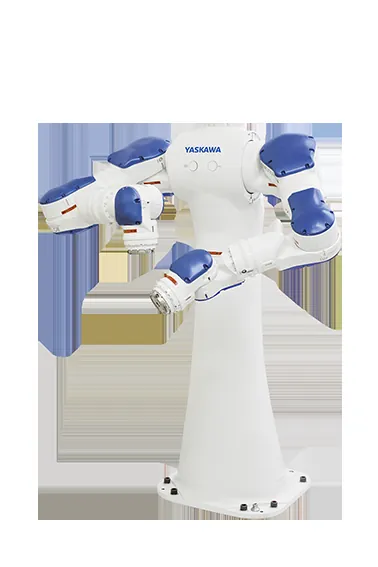
SDA series
Both wrists have 15 axes, working together.
Equipped with Yaskawa's self-developed Σ-7 servo system, it operates swiftly and offers high repeatability.
Supports loads from 0.5kg to 800kg, covering welding, handling, palletizing, spraying, and other scenarios.
High IP protection rating, suitable for harsh working conditions such as dust, oil stains, and humidity.
Core technologies and control cabinets
Yaskawa's self-developed servo and control technology provides robots with high-precision and highly reliable drive cores.
Next-generation standard control cabinet, compatible with GP/AR/SP/PL/HC series, supports multi-machine synchronization and IoT connectivity.
Ultra-compact control cabinet, compatible with MotoMINI, GP minicomputers, and collaborative robots.
Spray (MPX/MPO) and parallel/dual-wrist (MPP/SIA/SDA) dedicated control cabinets.
Independently developed high-performance servo with agile movement, high repeatability, and energy efficiency.
Application scenarios
From palletizing and welding to machine tool maintenance, assembly, dispensing, grinding, and quality inspection, Yaskawa can quickly deploy to various processes.
Service industry
Yaskawa YASKAWA is widely used in the following industries, and we can provide selection and implementation support tailored to local industry characteristics.
Why choose Yaskawa (YASKAWA).
Cumulative shipments exceeded 500,000 units, with large second-hand circulation and easy access to parts.
Fully covering loads from 0.5kg to 800kg, welding, handling, palletizing, spraying, and collaboration are all available.
Self-developed servo and control systems offer high repeatability, low failure rates, and long service life.
The domestic service network and spare parts system are mature.
Trusted by global customers
Yaskawa YASKAWA serves numerous globally renowned companies (brand logo copyrights belong to each individual).
Third-party services we provide
Henghuan Robotics Technology can provide full lifecycle services for Yaskawa equipment.
Process validation, workstation solutions, programming and teach-in and production ramp-up support, and turnkey delivery of robot applications.
Learn more → Sales of new industrial robotsAuthorized-style sales of brand-new mainstream robots with selection support for new production lines and capacity expansion.
Learn more → Research and development of automation equipmentResearch, development, integration, and delivery of end-effectors, conveyor positioning, safety peripherals, and complete control systems.
Learn more → Research and development of algorithms and control systemsMotion planning, machine vision, and PLC/SCADA system development to address takt-time bottlenecks, accuracy, and data interconnection.
Learn more → Robot rentalShort-term rental, long-term rental and lease-to-own for in-stock models, long-term rental, and lease-to-purchase transfer, including transportation, installation, commissioning, and lease-term maintenance.
Learn more → Software and hardware upgrade servicesController retrofits, software and firmware upgrades, mechanical refurbishment, and safety upgrades restoring performance to older equipment.
Learn more → Maintenance and repairOn-site inspection, fault diagnosis and repair, and annual maintenance contracts covering 1,310 models from 21 brands.
Learn more → Used & in-stock robot salesWe buy back used robots and handle inspection, refurbishment and resale; every unit ships with inspection records and a warranty, and trade-ins can offset new purchases.
Learn more →Yaskawa YASKAWA Frequently Asked Questions
Focusing on the selection, maintenance, parts, and second-hand distribution of Yaskawa equipment, we answer the most frequently asked questions from customers.
What should I do if Yaskawa Robot loses Zero Point? How do you start over from the starting point?
If the encoder's backup battery dies after power outage and re-energizes, it will report that the origin is not set, causing all axes to be positioned chaotically. Processing sequence: first replace the battery, then enter the teach pendant's Home Return menu, align the axis to the origin marker on the machine body—marking line or pin—and set the absolute value. Then power off and power on to verify once. After finishing, remember to recheck the interference zone and soft limit. Models with absolute encoders generally do not require full reset, as long as the battery has never been interrupted.
How do you distinguish the Yaskawa YRC1000, DX200, and FS100 cabinet types?
Yaskawa classifies by model: GP, AR, SP, PL, HC are mainstream machines with YRC1000; MotoMINI uses the YRC1000micro, while SCARA's SOC series uses the YRC1100micro; Sprayed MPX and MPO go DX200; Parallel MPP, single-arm SIA, and double-arm SDA follow FS100. Their software is not interchangeable, so programs cannot be directly copied. Before searching for second-hand cabinets or ordering cards, you must first check the cabinet type; just looking at the robotic arm model won't match.
Is it easy to find Yaskawa robot parts? How long does maintenance take?
Yaskawa has shipped over 500,000 units cumulatively, with a large domestic stock. Channels for regular parts like batteries, fans, cables, and teach pendants are smooth, and the self-developed Σ-7 servo system accessories are also easy to assemble. The challenge lies in the dedicated cabinet types—DX200 and FS100—whose board circulation is YRC1000 small, so when you need to replace boards, the order cycle will be extended. We do not preset the number of days; after testing, we provide an estimate according to the plan. The service center is in Nanchong, and on-site testing is available in Sichuan, Chongqing, Yunnan, and Guizhou.
What processes is Yaskawa Robotics suitable for? Which series are used the most?
Yaskawa's load covers 0.5kg to 800kg, with series divided very finely. Welding is our specialty: AR series for arc welding, from AR700 to AR2010; SP series is used for spot welding and handling, weighing 80-235kg, commonly seen on automotive body lines. GP series for general transport, GP4 all the way to GP600; Palletizing includes the PL series, with 4-5 axes and 80-800kg; Spray is MPX and MPO series, explosion-proof design; For human-machine collaboration, choose the HC series; for dual-arm assembly, choose SDA.
How is the retention rate of Yaskawa used robots? Is it easy to sell second-hand?
Yaskawa has a large circulation of second-hand machines, especially GP series and AR series welding machines, which are frequently sold during renovations at auto parts and metal processing factories. Value retention depends on cabinet type: models with YRC1000 sold better than those with DX200 or FS100, which are more specialized and have a narrower audience. When buying second-hand, focus on checking operating hours and reducer backlash. For welding machines, also check the condition of the water-cooled cables. Prices are determined based on equipment model, fault status, and maintenance plan, and a quotation will be issued after inspection.
What are the common types of faults in Yaskawa robots?
The most concentrated categories are: encoder backup battery depletion leading to loss of origin, which is the most common; GP series RV reducers worn out during long-term full-load operation, manifesting as positioning drift and abnormal noises; TCP offset and wrist gear damage caused by welding machine type torch collisions; Spraying model MPX sealing and pipeline aging in paint mist environments; Control cabinet fans and capacitors are aging. Yaskawa alarms are divided into major faults and light alarms; severe faults directly cut off the servo, while light alarms can be manually operated.
Can older Yaskawa robots (XRC, NX100 generation) still be repaired?
It can be repaired, but the cost must be calculated first. The mechanical parts are basically no obstacles; the reducer, seals, and wiring harnesses are all handled; The problem lies in the electronic control—early cabinet types like XRC, NX100, DX100 have long been discontinued officially, so we can only rely on disassembling components and repairing boards. How much we can find is not entirely up to us. Another practical issue is that running old versions of software on old systems makes adding visual and bus communication more difficult. Fix local faults; for systemic aging, evaluate and replace the entire machine.
Need technical support or model selection from Yaskawa Robotics?
Please tell us about the equipment series, load, working radius, application processes, and current status (new/in-use/used/used). We offer targeted third-party solution recommendations.
Contact Henghuan