
Embodied AI Industrial Robots
From demos to real shifts: general intelligence in the physical world
Preface: why embodied AI is the next act of industrial robotics
For four decades industrial robots lived on teach-and-playback: engineers baked trajectories into controllers and the machine repeated them ten thousand times inside a fence. After 2024 that path was rewritten - vision-language-action (VLA) foundation models let a robot understand natural-language instructions, perceive open scenes and translate both into millisecond-level joint torques. The first VLA survey in IEEE TNNLS (2026) frames embodied AI as a cornerstone of AGI: intelligence no longer lives only in text and pixels, it must be validated in a physical body that collides, wears and slips.
This hub is not a concept primer but an audit of verifiable facts: who ran how many hours on a live line, moved how many parts, at what accuracy; whose data factory produces how many trajectories per day; how cloud large models and on-device small models split the work. Every figure carries its source basis, and disputed numbers (e.g. Tesla Optimus output) are presented with both claims.
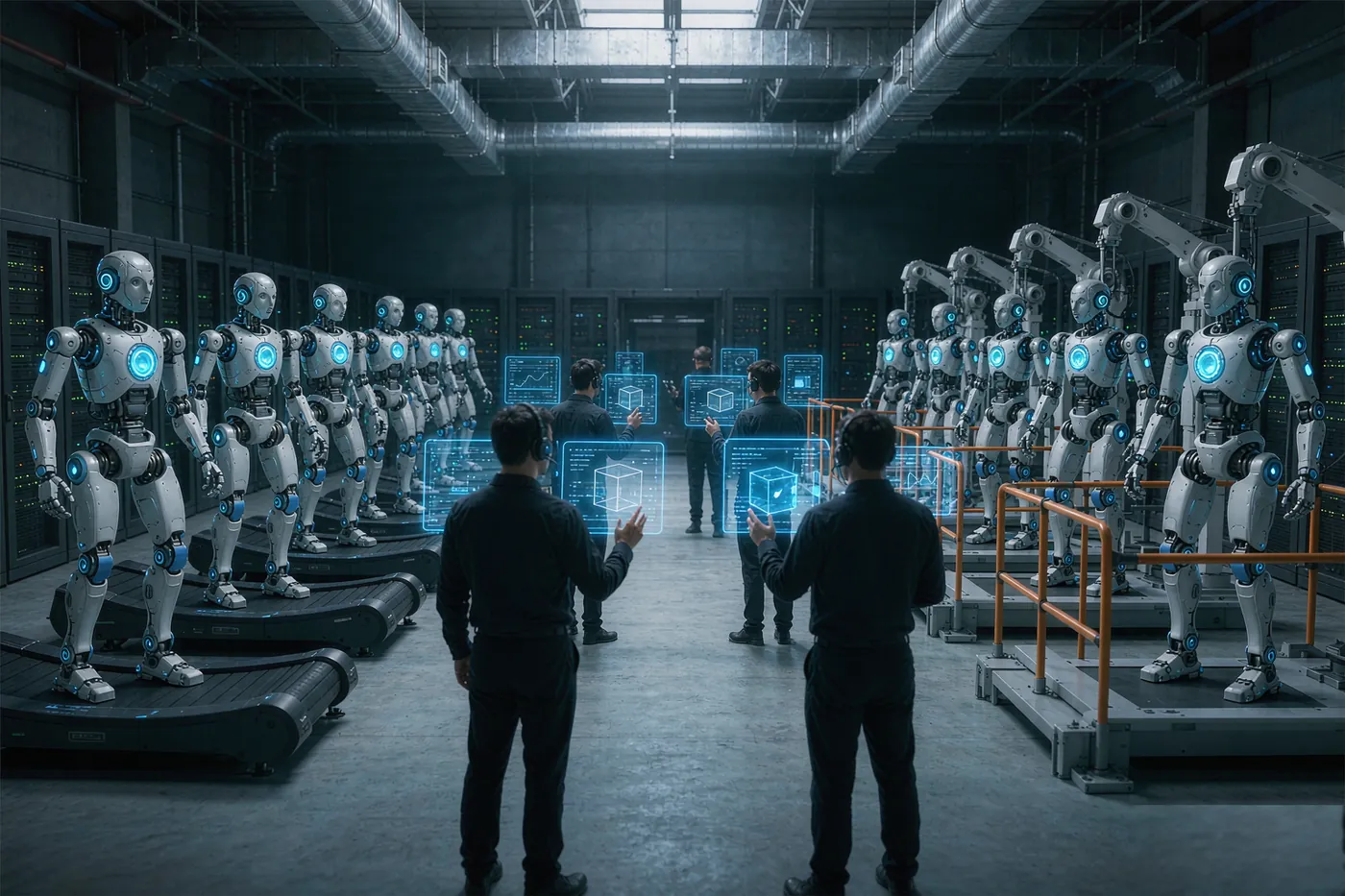
Five facts about industrial embodied AI in 2026
One: deployment is real but narrow. Figure 02's eleven-month pilot at BMW Spartanburg logged 1,250+ hours, 90,000+ sheet-metal parts, 99%+ placement accuracy on an 84-second cycle, supporting 30,000+ X3 builds; Agility's Digit moved 100,000+ totes at GXO with 65,000+ cumulative hours. Yet every verified case is repetitive material work in structured environments - none runs long-term unsupervised in unstructured settings.
Two: Chinese vendors lead on volume and data flywheels. In H1 2026 AGIBOT shipped ~8,400 units (~44% global share) and Unitree ~5,900 (~31%) - together about three quarters of global humanoid shipments; AGIBOT's 4,000 m2 Shanghai data factory runs ~100 robots producing 30-50k trajectories daily, and its open AgiBotWorld dataset supplies ~80% of the real-robot data behind NVIDIA GR00T N1.
Three: the 'brain' is tiering. Cloud-scale VLA models plan at 1-3 Hz, distilled sub-10B on-device models run control at 200 Hz-1 kHz, and factory edge servers handle fleet coordination at 5-50 ms. Tesla Dojo, NVIDIA Jetson Thor (2,070 FP4 TFLOPS at 40 W) and Cosmos 3 Edge are the three anchors of this chain.
Four: academic boundaries are melting. VLA, world models and AGI cross-cite each other in 2026 papers: world models give VLAs a future predictor, VLAs give AGI a physical testbed. A Tongji/UESTC survey (Jan 2026) taxonomizes world models into four paradigms: world planner, world action model, world synthesizer, world simulator.
Five: scenarios unfold in the order industry - logistics - commercial - home, with industry plus logistics already above 70% of shipments; meanwhile home, outdoor, sports and underwater long-tail scenarios are being covered by quadruped, wheeled and humanoid morphologies - a dedicated chapter follows.
How to read this hub
The four international leaders (Figure, Agility, Boston Dynamics, Tesla) and four Chinese leaders (AGIBOT, Unitree, UBTECH, Galbot) each get a spec-and-data dossier; 'Academic boundaries' covers the VLA/world-model/AGI convergence; 'Cross-scenario applications' spans factory, home, outdoor, sports and underwater; 'Cloud-edge architecture' covers the compute revolution. As a third-party service house, Henghuan closes each page with our maintenance, used-equipment and upgrade stance for that class of machines.
Hub index
Models, line records and training data of Figure / Agility / Boston Dynamics / Tesla
Details →Chinese Top 4Shipments, data factories and industrial pilots of AGIBOT / Unitree / UBTECH / Galbot
Details →Academic BoundariesThe convergence of VLA, world models and AGI
Details →Cross-Scenario AppsFactory, home, outdoor, sports, underwater
Details →Cloud-Edge ArchitectureCloud models issuing instructions, edge executing: the compute revolution
Details →Collaborative ArmsThe 'semi-embodied' form before embodied AI
Details →FAQ
What separates embodied-AI robots from traditional industrial robots?
Traditional machines are program executors: a task change means reprogramming and relayout. Embodied machines are instruction interpreters: a natural-language goal is decomposed into subtasks by a VLA model that emits actions - new line, same code. The price is that dependence on training data and compute shifts from one-off integration to continuous operation.
Is it economical to put embodied robots on the floor today?
It depends on task structure. For repetitive material work - tote moving, machine tending, inspection - paid commercial cases exist in 2026 (Digit at GXO, Figure at BMW); unstructured fine assembly still favours mature cobot-plus-vision solutions. Henghuan's stance: validate takt and failure rate via rental first, then decide on purchase.